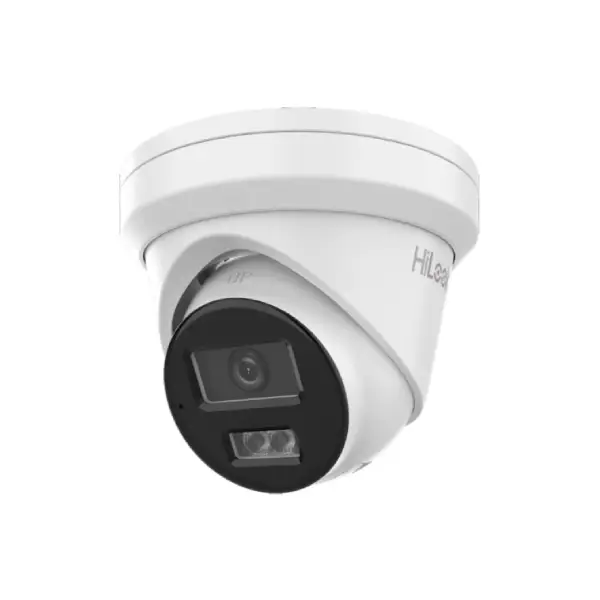

SKU:IPC-T381H-MU
HiLook 8MP IPC-T381H-MU AI Fixed Turret Network Camera
Enhance your security system with the Hikvision HiLook 8MP IPC-T381H-MU AI Turret IP Camera. This camera offers high-quality 8-megapixel resolution for detailed surveillance footage. The Hikvision HiLook 8MP IP Camera offers a range of advanced features to enhance your surveillance system:
- High-Resolution Imaging: Delivers detailed 8-megapixel resolution for clear and precise video capture.
- Intelligent Detection: Utilizes deep learning algorithms for accurate human and vehicle classification, reducing false alarms.
- Integrated Audio: Equipped with a built-in dual-microphone array, providing real-time, high-quality audio monitoring.
- Wide Dynamic Range (WDR): Employs 120 dB true WDR technology to ensure clear imaging even in challenging lighting conditions with strong backlight.
- Efficient Compression: Supports H.265+ compression technology, optimizing bandwidth and storage without compromising image quality.
- Durable Design: Features an IP67-rated enclosure, offering water and dust resistance for reliable outdoor use.
-
Vendor:
HiLook
- Tags: 8mp, Turret camera

- Description
Product Overview
Eight megapixels is 4K, and 4K is the number most people are shopping for. It is worth understanding what it actually buys you, because the answer is not simply "a better picture."
What 8MP buys you is crop headroom. When you review footage, you almost never watch the whole frame — you zoom into the corner where something happened. At 3840 × 2160 there is still real image data left after that crop. At 2MP there is not, and no amount of software sharpening recovers detail the sensor never captured.
The HiLook IPC-T381H-MU pairs that resolution with the features that make it usable day to day: AcuSense AI classifying people and vehicles on the camera before an alert fires, 120 dB True WDR for backlit entrances, dual EXIR illumination to 30 m, a built-in microphone, microSD recording to 512 GB, IP67 sealing rated from −30°C to 60°C, and single-cable PoE. It suits driveways, shopfronts, warehouse zones and residential perimeters from a single mounting point.
Key Capabilities
8MP 4K Resolution
3840 × 2160 on a 1/2.7″ progressive scan CMOS — roughly four times the pixel count of a 2MP camera. The benefit shows up in review rather than live view: you can crop hard into a frame and still have something identifiable, which is what turns a recording into evidence.
AcuSense Human and Vehicle Classification
On-camera AI decides whether motion came from a person, a vehicle, or something you do not care about — before any alert is sent. Possums, moths, moving foliage and shadow shift are discarded. Recorded footage also becomes searchable by target type, which turns an overnight review from an hour into a minute.
120 dB True WDR
True wide dynamic range at 120 dB solves the most common outdoor framing failure: a person standing in a doorway with bright sky behind them, reduced to a silhouette. Both shadow and highlight detail survive in the same frame — which matters enormously on glass-fronted retail and west-facing entries.
30 m Dual EXIR Night Vision
Two EXIR LEDs spread illumination evenly across the full field of view rather than producing a bright centre and dark edges, which is the usual failing of cheap IR arrays. Reaches 30 m in complete darkness with no external lighting required.
Built-In Microphone
Records ambient audio alongside video, adding the context a fixed camera angle leaves out — a verbal exchange at a counter, a vehicle idling out of frame, an impact you would otherwise be guessing at. Microphone only; there is no speaker, so two-way talkback is not supported.
512 GB MicroSD Edge Storage
Double the card capacity of most cameras in this class — genuinely useful at 8MP, where files are large. Enough for real standalone operation on an outbuilding or gate, or as a backup layer so footage survives on the camera if the recorder is stolen or drops offline.
H.265+ Compression
Essential rather than optional at 8MP. H.265+ drops the bitrate through static periods and lifts it when something happens, which meaningfully offsets the storage cost of 4K. Without it, a four-camera 8MP system would eat drive capacity at an uncomfortable rate.
IP67 Rated −30°C to 60°C
Fully dust-tight and sealed against water ingress, with an operating range that covers alpine frost through to a Western Sydney summer or a metal roof cavity in January. Suits exposed eave, fascia and wall positions including coastal and high-UV sites.
PoE and ONVIF
Standard 802.3af PoE means one Cat5e or Cat6 run carries data and power together, with no plug pack in the roof cavity. ONVIF support gives baseline interoperability with third-party recorders, though AcuSense event handling works best within the HiLook and Hikvision ecosystem.
Best For
Wide coverage with 4K crop headroom
120dB WDR handles the backlight problem
Detail at distance from 3–4m mounting
AcuSense removes the false alert problem
IP67, −30°C to 60°C rated
512GB card records without an NVR
Why Choose the IPC-T381H-MU
This camera sits at a specific point in the market: 4K resolution with on-camera AI classification, at a price well below the commercial Hikvision equivalents. That combination is the whole argument for it.
Resolution without AI is a false economy. A basic 8MP turret records beautiful footage of everything, and alerts on everything too — wind through a hedge, cars passing on the street, shadows crossing a wall at dusk. Within a fortnight the notifications are muted and the system has quietly stopped being useful. AcuSense processes motion on the camera and only raises an alert when a human or vehicle is confirmed, which is what keeps the system in daily use rather than sitting ignored.
Around that, the specification is genuinely well judged for Australian conditions. 120 dB WDR handles the harsh backlight of a glass shopfront or a west-facing door. Dual EXIR gives even illumination rather than a hot centre. The IP67 housing is rated across a temperature range that comfortably exceeds anything a roof cavity in Melbourne or a coastal wall in Sydney will produce. And 512 GB of edge storage is meaningful headroom at a resolution where files are large.
Total Security Equipment stocks the HiLook range across our Melbourne and Sydney showrooms with compatible NVRs, brackets, surveillance-rated storage and PoE gear, trade accounts for installers, and honest advice on whether 8MP is actually the right call for your site — see the first buyer tip below, because sometimes it is not.
Buyer Decision Tips
Ideal Use Cases
Residential Driveways and Entries
A 102° view from an eave covers the full driveway approach plus the front door in one frame, and 8MP means you can crop into the section that matters afterwards. AcuSense is what makes it liveable on a street-facing property — without classification, every passing car would fire an alert.
Glass-Fronted Retail and Shopfronts
A glass shopfront is the hardest lighting scenario in retail: brilliant outside, dim inside, the subject in between. 120 dB True WDR is the specific feature that saves these shots, keeping faces visible instead of reducing everyone entering to a black outline. The microphone adds the verbal side of any counter incident.
Warehouse Bays and Stockrooms
Mounted at three to four metres, the wide field of view covers a full loading bay or stockroom aisle, and 8MP gives enough density to make out what someone is carrying rather than simply that someone was there. Useful where stock shrinkage is the concern rather than break-ins.
Commercial Perimeters and Car Parks
Open areas need both coverage and evidence quality, which is exactly the trade this camera manages. AcuSense keeps overnight alerts credible, and the IP67 housing rated to 60°C handles exposed positions on rooftops and unshaded walls without the accelerated failure common to lesser enclosures.
Outbuildings, Gates and Standalone Points
Some positions are simply not worth cabling back to a central recorder — a rear shed, a paddock gate, a detached garage at the end of a long run. With 512 GB of microSD storage the IPC-T381H-MU works as a self-contained unit at those points, recording locally and accessible through the mobile app. Fit a high-endurance card, and treat it as a genuine camera rather than a compromise: it is the same 8MP sensor and the same AcuSense filtering as the cameras on the main system.
Choosing the Right Model
Choose this model if…
- You want maximum crop headroom for reviewing footage after an incident.
- The site has reasonable ambient light, or you are relying on the 30 m IR rather than pushing low-light limits.
- False alerts are a frustration and you want on-camera AI classification.
- You have a high-contrast entrance where 120 dB WDR will earn its keep.
- You want audio recorded alongside video without a separate device.
- Your recorder handles 8MP per channel and you have drive capacity for it.
Choose a different model if…
- The site is genuinely dark and low-light performance matters more than pixel count. The 6MP T361H-MU has a better low-light rating on the same sensor size.
- You want colour footage at night. This is an infrared camera and records greyscale after dark — a ColorVu or dual-light model retains colour.
- You want an active deterrent. No strobe or speaker here; the AcuSense all-in-one range adds light and audio warning on detection.
- You need to adjust framing after mounting. Fixed lens — a varifocal gives you on-site flexibility.
- You need two-way voice. Microphone only, no speaker.
- You need readable plates on moving vehicles. That is a dedicated ANPR job, not a wide-angle overview camera.
FAQs
Is 8MP actually better than 6MP?
For daylight detail and crop headroom, yes. For low light, not necessarily. Both cameras use a 1/2.7″ sensor, so fitting 8 million pixels onto it means each pixel is smaller than on a 6MP version and gathers less light. The published minimum illumination reflects that: 0.01 Lux for this 8MP model against 0.003 Lux for the 6MP T361H-MU. If your site is well lit or you are relying on the infrared, choose 8MP. If it is genuinely dark, the 6MP may serve you better.
What does AcuSense do?
It classifies each motion event as human, vehicle, or neither, on the camera itself, before anything is sent. Two things follow: notifications can be limited to people and vehicles, filtering out the animals, insects and foliage that make untuned motion alerts unusable within a week; and recorded footage becomes searchable by target type, so reviewing an overnight period takes minutes instead of hours.
How far away can it identify someone?
Realistically within about 15–20 metres on the 2.8 mm lens. The wide 102° field of view spreads the 8 million pixels across a large scene, so subjects further out occupy fewer pixels regardless of the headline resolution. Beyond that range, treat the footage as showing that something happened rather than reliably identifying who. For detail further out, use the 4 mm variant or mount closer to the area of interest.
2.8 mm or 4 mm — which should I choose?
Start from the shape of the area, not its size. The 2.8 mm gives roughly 102° and suits wide, shallow spaces viewed from close range — driveways, courtyards, shop entrances, indoor rooms. The 4 mm narrows the view and concentrates the same resolution across less area, which is what you want for a long driveway, a gate or a corridor. The lens is fixed, so this is decided at order time. Tell us the site layout and we will advise.
Does it record in colour at night?
No. This is an infrared camera — once ambient light drops below the switching threshold it moves to IR and records in greyscale. If keeping colour after dark matters, look at ColorVu or dual-light models instead, which either run a continuous white light or trigger one on detection.
How much storage will four of these use?
Considerably more than a 1080p or 4MP system, which is the practical cost of 4K. H.265+ compression offsets much of it by lowering the bitrate during static periods, but not all. If you have a retention target in mind — 30 days is common for insurance — tell us the camera count, resolution and frame rate and we will size the drive properly rather than guessing.
Will my existing NVR handle it?
Check two things: maximum recording resolution per channel, and total decoding capacity. A recorder capped at 4MP per channel will downscale the stream and waste the resolution you paid for. Separately, many recorders record all channels at full resolution but display multi-camera split-screen at 1080p — that affects live view only, not the recorded evidence. Send us your NVR model and we will confirm compatibility.
Can it record without an NVR?
Yes — a microSD card up to 512 GB supports continuous or event-triggered recording on the camera, viewable through the mobile app. That is genuinely useful capacity at 8MP. Use a high-endurance or surveillance-rated card; standard consumer cards are not designed for continuous writing and typically fail within months, usually silently.
Does it support two-way audio?
No. The built-in microphone records ambient audio, but there is no speaker, so you cannot speak through the camera or trigger an audio warning. If you want active deterrence with a voice warning, look at the AcuSense all-in-one range with strobe and speaker.
Is it legal to record audio in Australia?
Surveillance device laws are set at state and territory level and they differ meaningfully. As a general principle, recording private conversations without any party's knowledge is restricted. Entrances, external perimeters, yards and commercial premises with clear signage are usually the appropriate places to enable audio. Check the legislation applying in your state — in Victoria this is the Surveillance Devices Act 1999 — before switching the microphone on, and seek legal advice where the site is a workplace, shared, or publicly accessible.
Can it go on an exposed wall in full sun?
Yes. IP67 means fully dust-tight and sealed against water, and the operating range of −30°C to 60°C covers unshaded walls, rooftops and roof cavities in Australian summer conditions. The rating applies to the camera body — seal the cable entry and use a weatherproof junction box for any splice, because that join is where outdoor failures almost always begin.
Where can I buy it and what support is included?
Available from Total Security Equipment online and across both showrooms, with Australia-wide shipping and compatible HiLook NVRs, brackets, junction boxes and surveillance storage in stock. Trade accounts and volume pricing are available for installers, and our team can advise on lens choice, camera count, drive sizing and NVR compatibility before you order.
Additional Information
Showrooms
Sunshine North, Melbourne
26 Davies Ave, VIC 3020
Fairfield East, Sydney
38 Lisbon Street
Ordering & Support
- Australia-wide shipping
- Available in white or black
- Compatible HiLook NVRs, brackets and storage in stock
- Trade accounts and volume pricing for installers
- Phone support on lens choice, drive sizing and NVR compatibility
- Download Spec Sheet
- Quick Start Guide
Not sure whether 8MP or 6MP suits your site better, or how much storage you will need? Call 03 9079 5566 or visit a showroom — we will spec the whole system with you before you order.
Key Features & Technical Specifications
| Camera | |
|---|---|
| Image Sensor | 1/2.8" Progressive Scan CMOS |
| Max. Resolution | 3840 × 2160 |
| Min. Illumination | Color: 0.005 Lux @ (F1.6, AGC ON), 0 Lux with light |
| Shutter Time | 1/3 s to 1/100,000 s |
| Day & Night | IR cut filter |
| Angle Adjustment | Pan: 0° to 360°, tilt: 0° to 75°, rotate: 0° to 360° |
| Lens | |
| Lens Type | Fixed focal lens, 2.8 and 4 mm optional |
| Focal Length & FOV | 2.8 mm: Horizontal 108°, Vertical 59°, Diagonal 127° 4 mm: Horizontal 88°, Vertical 44°, Diagonal 105° |
| Aperture | F1.6 |
| Video | |
| Main Stream | 50 Hz: 20 fps (3840 × 2160), 25 fps (1080p/720p) 60 Hz: 20 fps (3840 × 2160), 30 fps (1080p/720p) |
| Compression | H.265 / H.264 / H.264+ / H.265+ |
| Network | |
| Protocols | TCP/IP, ICMP, HTTP, HTTPS, FTP, DHCP, DNS, DDNS, RTP, RTSP, NTP, UPnP, SMTP, IGMP, 802.1X, QoS, IPv4, IPv6, UDP, Bonjour, SSL/TLS |
| API | ONVIF (Profile S, Profile G), ISAPI, SDK, ISUP |
| General | |
| Power | 12 VDC ± 25%, max. 8 W; PoE (802.3af, Class 3), max. 9.5 W |
| Protection | IP67, IK10 (if applicable), Metal Housing |
| Weight | Approx. 515 g (1.1 lb.) |