SKU:IPC-HDW3649H-AS-PV-ANZ
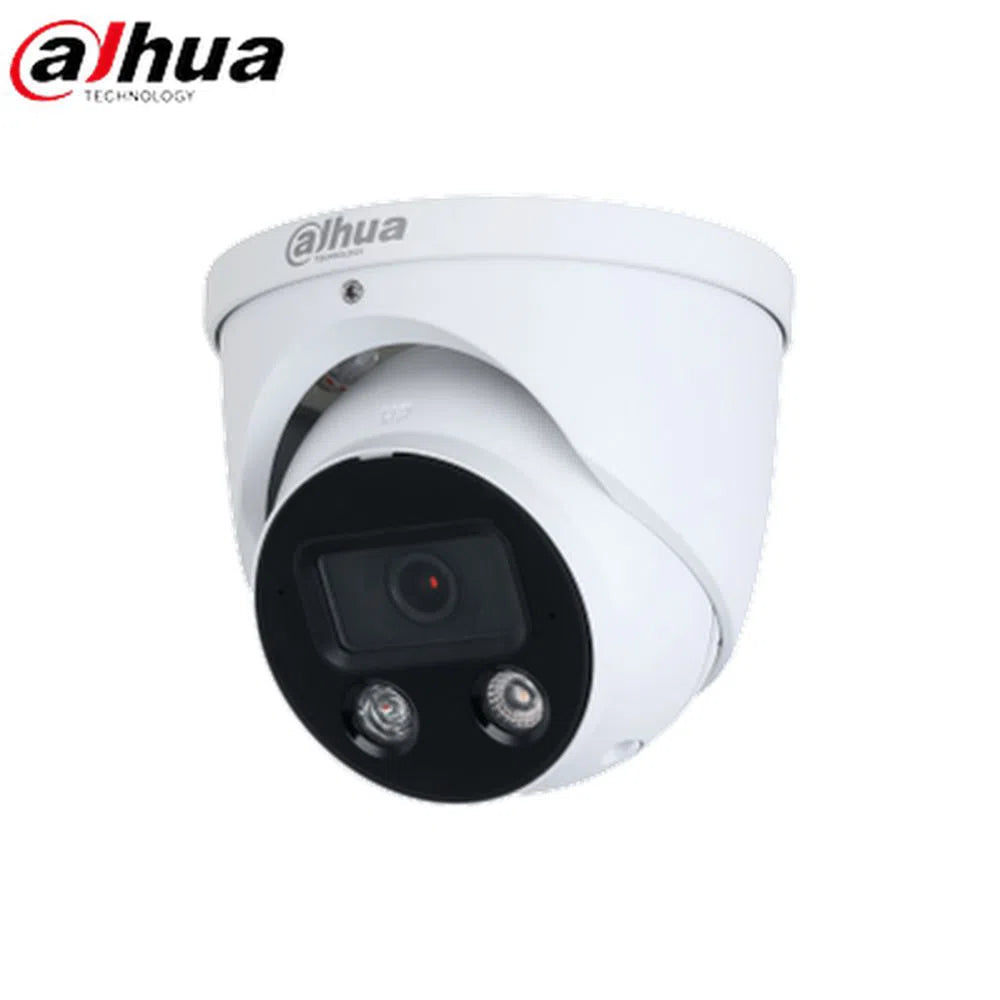
Dahua 6MP TiOC 2.0 Turret Network Camera Series 3 - IPC-HDW3649H-AS-PV-ANZ
Key Features
- 6-MP 1/2.7" CMOS image sensor, low luminance, and high definition image
- Outputs max. 6 MP (3072 ×2048)@25/30 fps.
- H.265 codec, high compression rate, ultra-low bit rate.
- Built-in warm light and IR LED; the max. IR illumination distance is 30 m and warm light distance is 30 m.
- ROI, SMART H.264+/H.265+, AI H.264/H.265, flexible coding, applicable to various bandwidth and storage environments.
- Rotation mode, WDR, 3D NR, HLC, BLC, digital watermarking, applicable to various monitoring scenes.
- Intelligent monitoring: Intrusion, tripwire (the two function support the classification and accurate detection of vehicle and human).
- Abnormality detection: Motion detection, privacy masking, scene changing, audio detection, no SD card, SD card full, SD card error, network disconnection, IP conflict, illegal access, and voltage detection.
- Alarm: 1 in, 1 out; audio: 1 in, 1 out; supports max. 256 G Micro SD card; buit-in dual Mic; 1-ch speaker; support two-way talk.
- 12 VDC/PoE power supply.
- IP67 protection.
- Sound and light alarm (red and blue lights).
- SMD 4.0.
- Supports AI SSA and one-tap arming and disarming.
- SMD area can be set in warm light areas that support triggering alarms.
-
Vendor:
Dahua
- Tags: 6mp, Tioc, Turret camera
Buying from us? You get more than just the product.
Free Pre-Programming
We can pre-configure eligible products so they're ready to install.
Free 45 Mins Onsite Support
Stuck on the job? We'll come to you. Eligible purchases include up to 45 minutes of onsite support.
Project Management
From plans to handover. We assist with design, equipment selection, programming and commissioning.
End-User Support
We help support your customers too. Give your customers the confidence with reliable local support.

- Description
Product Overview
Every other camera on this site records what happened. This one tries to stop it happening.
The Dahua DH-IPC-HDW3649H-AS-PV-ANZ is a TiOC camera — Dahua's "three-in-one" concept combining surveillance, AI detection and active deterrence. When SMD 4.0 confirms a person in a zone you have defined, the camera does not simply log it and send a notification. Red and blue strobe lights fire, a siren sounds, and you can speak directly through the built-in speaker from your phone. Most people who were not supposed to be there leave at that point.
Underneath the deterrence sits a genuinely strong camera. A 6MP sensor behind an F1.0 lens — an unusually wide aperture at this level — delivers a 0.003 lux colour rating, and smart dual illuminators run infrared as standard then switch to warm white light for full-colour capture the moment a target is detected. Add two-way talk through dual microphones, SMD 4.0 with tripwire and intrusion zones, 120 dB-class image processing, IP67 sealing and single-cable PoE, and this is the camera for sites where recording alone has stopped being enough.
Key Capabilities
Active Deterrence: Strobe and Siren
Red and blue strobe lights combined with an audible siren, triggered automatically when a person or vehicle is detected in a defined zone. The value is in the timing — a warning that fires while someone is still deciding whether to proceed is worth considerably more than footage reviewed the next morning.
Two-Way Talk With Dual Microphones
Dual built-in microphones and a speaker let you speak directly to whoever is on site from the DMSS app, wherever you are. Pre-recorded voice warnings can also fire automatically on detection. Being addressed by name from a camera is a markedly more effective deterrent than a generic alarm.
SMD 4.0 Human and Vehicle Classification
Deep learning classification separates people and vehicles from animals, foliage and shifting shadows. On this camera the accuracy matters doubly: it controls your notifications and it decides when the siren fires. A camera that alarms at possums becomes a neighbourhood problem very quickly.
F1.0 Lens and Starlight Imaging
An F1.0 aperture is exceptionally wide for a camera in this class, and it translates directly into a 0.003 lux colour rating — among the best low-light figures in the 3 Series. More light through the glass means less digital gain, which means cleaner images rather than the smeary noise that ruins most low-light footage.
Smart Dual Illumination
Infrared and warm white LEDs, both reaching 30 m. The camera sits on infrared through ordinary night hours — dark and unobtrusive — then switches to warm white for full-colour capture the moment a person or vehicle is confirmed. Colour evidence when it counts, without a light burning all night.
Perimeter Protection Zones
Tripwire and intrusion rules let you draw a line across a gate or a zone around a yard, with alerts and deterrence triggering only when a classified target actually crosses it. This is what keeps the siren firing at genuine events rather than at every car passing on the street.
One-Press Arm and Disarm
Deterrence can be armed and disarmed from the DMSS app in a single tap, so the strobe and siren run overnight or when the property is empty, and stay quiet while the family is in the back yard. This is the feature that makes active deterrence liveable rather than something you switch off after a week.
AI Coding and H.265+
Smart H.265+ and H.264+ plus Dahua's AI coding, which analyses scene content to cut bitrate by a further margin again. Practically, that means 6MP footage without the storage bill you would expect — the difference between three weeks of retention and five on the same drive.
IP67 Housing, PoE Powered
Fully dust-tight and sealed against water for exposed eave, soffit and wall positions. Runs on standard 802.3af PoE so one Cat6 run carries data, power, video, audio and alarm control together. Image processing includes WDR, HLC, BLC, 3D NR, ROI, rotation mode and digital watermarking.
Best For
Intervention rather than documentation
Deters vehicle break-ins before entry
Siren on zone breach after hours
Voice warning without attending site
F1.0 lens and 0.003 lux colour rating
Response where nobody is nearby
Why Choose the DH-IPC-HDW3649H-AS-PV-ANZ
There is a moment most CCTV owners recognise: watching footage of someone walking around your property, knowing exactly what happened, and knowing there is nothing whatsoever you can do about it now. The recording is perfect. It just arrived twelve hours too late to matter.
Active deterrence exists to close that gap. When a person crosses into a zone you have defined, the response is immediate — strobe, siren, and your voice if you choose to use it. Most opportunistic offenders are looking for somewhere quiet and unobserved, and a camera that visibly reacts removes both conditions in about two seconds. The intent is that you never need the footage at all.
What makes it workable in practice is the AI underneath. Deterrence is only tolerable if it fires at the right things — a siren that goes off at cats and wind is a camera you will disable within a fortnight, and a problem with the neighbours besides. SMD 4.0 classification plus properly drawn perimeter zones means the alarm responds to people and vehicles crossing specific boundaries, not to general movement.
And when you do need footage, the imaging holds up. The F1.0 aperture is genuinely unusual at this price, giving a 0.003 lux colour rating, while the dual illuminators capture full-colour detail at the exact moment a target is detected.
Total Security Equipment supplies genuine Dahua Australian stock from showrooms in Melbourne and Sydney, with compatible NVRs, brackets and PoE gear on the shelf, trade accounts for installers, and local warranty handling.
Buyer Decision Tips
Ideal Use Cases
Driveways, Carports and Vehicle Storage
Vehicle break-ins are overwhelmingly opportunistic and depend on a quiet, unobserved few minutes. A strobe and siren firing as soon as someone approaches removes exactly that. Mounted at eave height across a driveway, the camera covers both the vehicles and the approach to the house, and the warm light captures colour detail at the moment of the trigger.
Yards, Sheds and Plant Storage
High-value equipment sitting unattended overnight is a standing target, and yards are usually too large to secure physically. An intrusion zone drawn around the compound with deterrence armed after hours means anyone entering meets light and noise immediately, while you get a notification and can speak through the camera from wherever you are.
Closed Retail and Commercial Premises
Loitering and after-hours access at shopfronts, rear doors and loading areas are common and rarely worth a call-out. Two-way talk lets a manager address someone directly from home — which resolves the great majority of these situations in seconds, without anyone attending the site or a monitoring bill.
Poorly Lit and Rural Properties
The F1.0 aperture and 0.003 lux rating make this a strong performer where ambient light is minimal, which is exactly the condition on most rural driveways and unlit rear boundaries. Deterrence matters more here too — response times are long, so a camera that intervenes on its own is doing genuine work.
Sites With a Recurring Problem
This is the clearest case for active deterrence: somewhere with a pattern rather than a one-off risk. People cutting through a property at night, repeat dumping in a laneway, ongoing interference with a bin area or a rear entry, the same group returning to a car park. Standard CCTV documents each occurrence and changes nothing. A camera that responds the moment someone enters the zone breaks the pattern itself, usually within the first few incidents — and the footage you do collect is in full colour with audio, which is considerably more useful if the matter goes further.
Choosing the Right Model
Choose this model if…
- You want the camera to intervene, not just record — you have a recurring problem rather than a hypothetical risk.
- You want to speak to people on your property from your phone.
- The site is poorly lit and low-light performance matters.
- You want colour footage of detected events without a light running all night.
- You can arm deterrence on a schedule and draw zones carefully.
- You are building on Dahua recorders and DMSS.
Choose a different model if…
- The camera is close to neighbours and a siren would cause more problems than it solves. A standard WizSense turret gives you the same AI detection quietly.
- You want continuous colour all night regardless of activity. That is a WizColor camera.
- You need adjustable framing or longer reach. The motorised varifocal TiOC offers 2.7–13.5 mm zoom with the same deterrence.
- You only need documentation, not intervention. Deterrence adds cost and configuration you will not use.
- You need readable plates on moving vehicles. That is a dedicated ANPR job.
- You are on a third-party NVR and cannot confirm it supports Dahua deterrence and event handling.
FAQs
What is a TiOC camera?
TiOC stands for Three-in-One Camera — Dahua's term for combining three things in one unit: full-colour imaging, AI detection, and active deterrence. The distinction from a normal camera is that last element. Instead of only recording an event and notifying you, it responds to it with light, sound and the option of your voice.
Does active deterrence actually work?
For opportunistic intrusion, generally yes — because opportunists depend on being unobserved and unhurried, and a strobe and siren removes both conditions immediately. It is less relevant against someone who has specifically targeted a property and expects a response. Treat it as a strong first layer that resolves most casual incidents on its own, not as a replacement for locks, lighting and an alarm system.
Will the siren go off constantly?
Not if it is set up properly. Deterrence triggers on SMD 4.0 classification, so it responds to people and vehicles rather than animals, foliage or shadows, and perimeter zones limit it further to specific areas. The two things that cause problems are zones drawn too wide — including a road or footpath — and leaving deterrence armed around the clock. Draw tightly, arm on a schedule, and it will fire when it should.
Can I turn the deterrence off when we are home?
Yes — one press in the DMSS app disarms it, and it can also run to a schedule. Recording and AI classification continue regardless; only the alarm response is suspended. Most people run it armed overnight and while the property is empty, and disarmed during normal household hours. Setting this up is the single thing that determines whether you keep using the feature.
Can I really talk to someone through it?
Yes. Dual built-in microphones and a speaker support live two-way talk through the DMSS app from anywhere with a connection, and pre-recorded voice warnings can be set to play automatically on detection. In practice a live voice is far more effective than a recording — being addressed directly ends most situations immediately.
Does it record in colour all night?
It records colour when something is detected. The camera runs infrared through ordinary night hours and switches to warm white light — giving full colour — when SMD 4.0 confirms a person or vehicle. That is deliberate: you get colour of the events that matter without a white light burning above your driveway all night. If you want an unbroken colour record regardless of activity, look at WizColor instead.
How good is it in the dark?
Very good for this class. The F1.0 lens is an unusually wide aperture and gives a 0.003 lux colour rating — among the strongest low-light figures in the 3 Series. A wider aperture lets in more light, so the camera needs less digital gain, which means cleaner images rather than the noise and smearing typical of low-light footage. Both illuminators reach 30 m.
Are there legal issues with the audio or the strobe?
Two things worth checking. Audio recording is governed by state and territory surveillance device legislation, which restricts recording private conversations — in Victoria that is the Surveillance Devices Act 1999. A speaker adds a further dimension in shared or public-facing spaces, so signage matters and legal advice is sensible for workplaces or publicly accessible sites. Separately, a siren near residential neighbours may fall under local council noise provisions, so it is worth a look at your council's requirements before installing.
Will it work on a non-Dahua NVR?
Video recording will generally work via ONVIF. Deterrence rules, perimeter zone management, SMD 4.0 event handling, two-way talk and DMSS integration depend on the recorder understanding Dahua events, which in practice means a compatible Dahua NVR. Since the deterrence is the entire reason to buy this camera, pairing it with a Dahua recorder is the sensible approach — we can confirm compatibility with what you already have.
How is this different from a normal camera with a spotlight?
A spotlight camera lights the scene so it can record in colour. This one does that too, but adds a genuine alarm response: red and blue strobe, an audible siren, and two-way voice — all triggered by AI classification within defined zones, and armable on a schedule. One improves your footage; the other tries to end the incident.
Where can I buy it and what support is included?
Available from Total Security Equipment online and across both showrooms, with Australia-wide shipping and compatible Dahua NVRs, brackets, junction boxes and PoE gear in stock. Trade accounts and volume pricing are available for installers, and our team can help with zone setup, deterrence scheduling and NVR pairing so the camera works properly from day one.
Additional Information
Showrooms
Melbourne
26 Davies Ave., Sunshine North, VIC 3020
Sydney
38 Lisbon St., Fairfield East, NSW 2165
Ordering & Support
- Australia-wide shipping
- Genuine Dahua Australian stock with local warranty support
- Compatible Dahua NVRs, brackets and PoE gear in stock
- Trade accounts and volume pricing for installers
- Phone support on zone setup, deterrence scheduling and NVR pairing
- Download Spec Sheet
Not sure whether active deterrence suits your site, or how to set the zones so the siren only fires when it should? Call 03 9079 5566 or visit a showroom — we will work it through with you before you order.