SKU:NVR4108HS-8P-AI/ANZ
Dahua 8 Channel NVR4108HS-8P-AI/ANZ Compact 1U 1HDD 8PoE WizSense NVR
Login to buy-
Vendor:
Dahua
- Tags: Lite series


Buying from us? You get more than just the product.
Free Pre-Programming
We can pre-configure eligible products so they're ready to install.
Free 45 Mins Onsite Support
Stuck on the job? We'll come to you. Eligible purchases include up to 45 minutes of onsite support.
Project Management
From plans to handover. We assist with design, equipment selection, programming and commissioning.
End-User Support
We help support your customers too. Give your customers the confidence with reliable local support.

- Description
Product Overview
The recorder is the part of a CCTV system nobody thinks about until something goes wrong. Cameras get the attention; the NVR quietly determines how far back your footage goes, how quickly you can find an incident, and whether the whole system stays up.
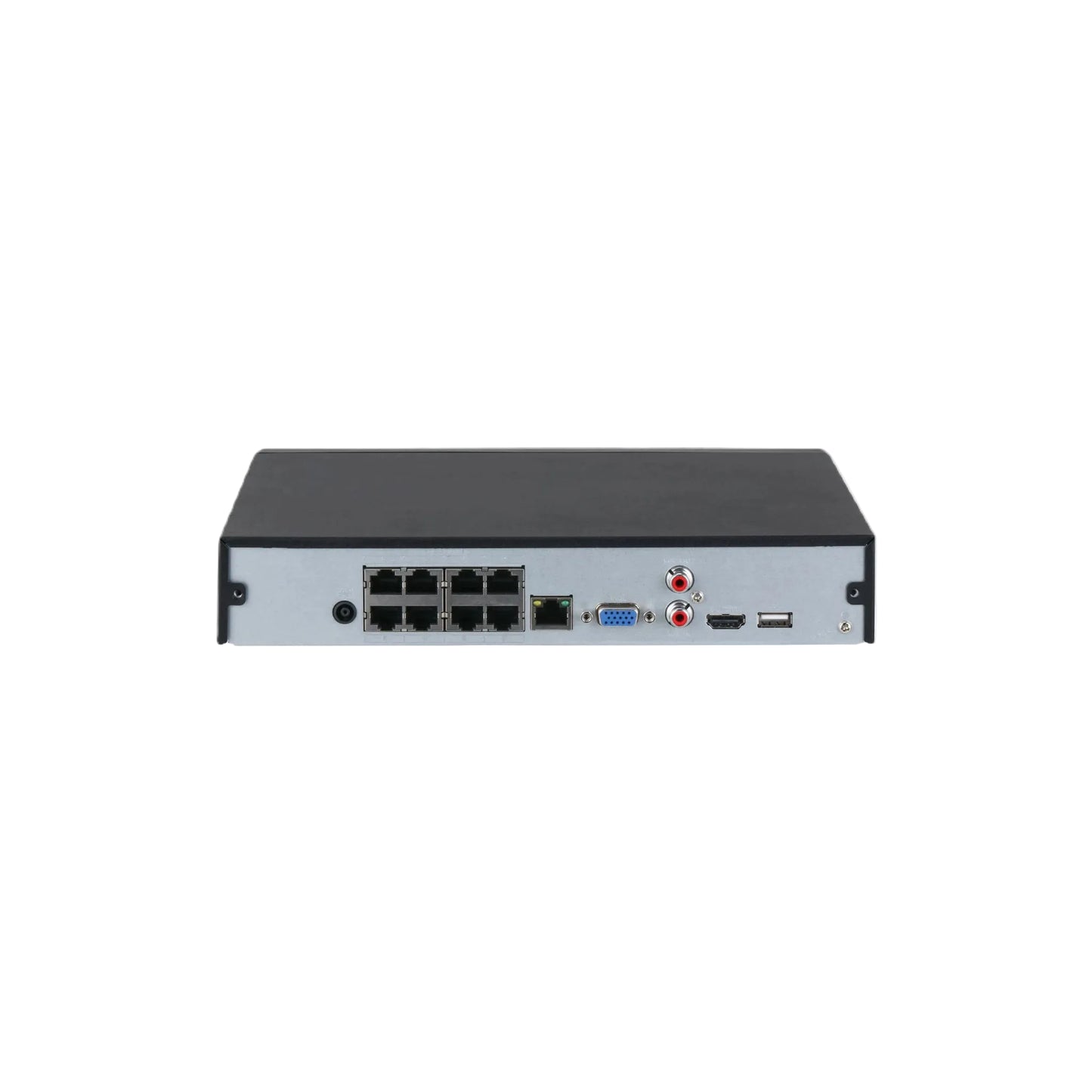
The Dahua NVR4108HS-8P-AI/ANZ is the sensible default for a system of up to eight cameras. Its practical advantage is the eight built-in PoE ports — cameras plug straight into the back of the recorder over a single Cat6 run each, carrying both data and power, with no separate PoE switch to buy, mount or configure.
Beyond that it is a genuinely capable recorder for the money. Smart H.265+ compression keeps storage demands manageable, 256 Mbps of incoming bandwidth handles eight cameras comfortably, and ONVIF and RTSP support mean it will work with third-party cameras rather than locking you into one brand. It also carries onboard AI — SMD Plus, perimeter protection and face detection — which is where this recorder gets interesting, and where most product listings get confusing. The section below explains exactly what that AI does and when it matters.
Understanding "AI by NVR" vs "AI by Camera"
This is the single most misunderstood thing about AI recorders, and it decides whether this NVR is right for your system. There are two completely separate ways AI can happen, and the specification lists both.
AI by Camera — no channel limits
If your cameras have their own onboard AI — every Dahua WizSense model does, running SMD 4.0, tripwire and intrusion on the camera itself — then the analysis happens before anything reaches the recorder. The NVR simply receives, records and manages those events. There is no per-channel restriction, because the recorder is not doing the work. This is how most modern systems should be built.
AI by NVR — limited channels
If your cameras cannot do their own analysis — older models, Lite-series cameras, or third-party units — the recorder can do it for them. That processing is finite, so it is capped: 4 channels of SMD Plus, 2 channels of perimeter protection, 1 channel of face detection. Useful for adding intelligence to cameras that have none, but not a substitute for AI cameras across a full eight-channel system.
What this means in practice: pair this recorder with WizSense cameras and every channel gets full AI classification, because each camera handles its own. Pair it with older or basic cameras and you get intelligent detection on up to four of them. Most people buying this NVR today are running WizSense cameras, in which case the channel limits never come into play — but it is worth understanding before you order rather than after.
Key Capabilities
Eight Built-In PoE Ports
Each channel has its own PoE port, so cameras connect directly to the recorder with one cable each carrying data and power. No separate PoE switch to buy, power or find space for, and Dahua cameras are detected automatically without manual IP addressing. On a residential or small commercial install this removes most of the complexity.
256 Mbps Incoming Bandwidth
Generous for an eight-channel recorder in this class — enough headroom to run higher-resolution cameras across all channels without throttling. Note this drops to 180 Mbps when NVR-side AI functions are enabled; see the buyer tips if you are planning eight 4K cameras.
SMD Plus on the Recorder
Smart Motion Detection Plus classifies motion as human or vehicle on up to four channels, filtering out animals, foliage and shadows. Genuinely useful for adding intelligence to older cameras that have none — turning a basic camera into one that only alerts on things worth knowing about.
Face Detection and Recognition
One channel of face detection and recognition with support for up to 10 face databases and 20,000 face images. Practical uses include staff or resident recognition at an entry point, or flagging known individuals at a commercial premises. Note the legal considerations covered in the buyer tips.
Perimeter Protection
Two channels of NVR-side tripwire and intrusion detection with human and vehicle classification. Draw a line across a gate or a zone around a yard and be alerted only when a classified target crosses it — available at the recorder for cameras that cannot do it themselves.
Smart H.265+ Compression
Supports Smart H.265+, H.265, Smart H.264+, H.264 and MJPEG, so it works with both current and older cameras. H.265+ is the one that matters for running costs — it compresses substantially harder than H.264, which translates directly into more weeks of footage on the same drive.
ONVIF and RTSP — Multi-Brand Support
Connects to third-party network cameras via ONVIF and RTSP, so you are not locked into a single brand and existing cameras can often be brought across during an upgrade. Full feature access still requires Dahua cameras, but basic recording works broadly.
Adaptive Decoding to 16 × 1080p
Maximum decoding capability of 16 channels at 1080p and 30 fps with adaptive decoding, which manages how much is displayed on screen at once. Recording resolution is unaffected — see the buyer tips for the distinction, because it is a common source of confusion.
Compact 1U Chassis, Security Baseline 2.3
A compact 1U form factor with a single drive bay, sized to sit in a comms cabinet, on a shelf or in a lockable cupboard. Dahua Security Baseline 2.3 covers the hardening features that matter on an internet-connected device — worth more than most buyers realise.
Best For
Full perimeter coverage with headroom
Entry, counter, stockroom, rear, car park
Full AI on every channel, no limits
ONVIF brings existing cameras across
NVR-side SMD Plus on up to 4 channels
Fast to commission, plug-and-play PoE
Why Choose the NVR4108HS-8P-AI/ANZ
Most of what makes a small CCTV install go badly happens at the recorder end. A separate PoE switch that turns out to be underpowered. Cameras that need manual IP addressing before they appear. A recorder that records fine but cannot handle the resolution the cameras produce.
This unit removes most of those failure points. The PoE is built in across all eight channels, so there is one less box to buy and one less thing to misconfigure. Dahua cameras are detected automatically, so there is no IP addressing step on a standard install. And 256 Mbps of incoming bandwidth means the recorder will not be the thing limiting your camera choice.
Eight channels is also the right number for most properties. Four fills up faster than people expect — front door, driveway, back door and side gate is four, with nothing left for the garage, the shed or a second storey. Eight gives genuine room to add positions later without replacing the recorder, which is by far the more expensive outcome.
The onboard AI is a useful bonus rather than the main event. If you are running WizSense cameras, they handle their own detection and the recorder simply manages the events. If you have older cameras with no intelligence at all, the NVR can add SMD Plus to four of them — which is a genuinely practical way to modernise an existing system without replacing every camera at once.
Total Security Equipment stocks the Dahua range across our Melbourne and Sydney showrooms alongside compatible cameras, surveillance-rated drives and accessories, with trade accounts for installers and phone support on system design. Tell us the site and we will tell you whether eight channels is enough before you buy.
Buyer Decision Tips
Key Features & Technical Specifications
| Model | NVR4108HS-8P-AI/ANZ |
| Channels | 8 channel |
| PoE Ports | 8 built-in PoE ports |
| Form Factor | Compact 1U, 1 HDD bay |
| Bandwidth | 256 Mbps access / storage / forwarding (180 Mbps with AI enabled) |
| Decoding Capability | Max. 16 × 1080p @ 30 fps, adaptive decoding |
| Compression | Smart H.265+ / H.265 / Smart H.264+ / H.264 / MJPEG |
| AI by NVR | 4-ch SMD Plus; 2-ch perimeter protection; 1-ch face detection and recognition |
| Face Database | Up to 10 databases, 20,000 face images |
| AI by Camera | Face detection and recognition, perimeter protection, SMD Plus, ANPR, people counting, stereo analysis, heat map |
| Third-Party Support | ONVIF and RTSP |
| Storage Options | Edge, central or backup |
| Security | Dahua Security Baseline 2.3 |
| Series | WizSense Lite Series |
| Hard Drive | Not included — surveillance-rated drive required |
Ideal Use Cases
Full Residential Coverage
Eight channels covers a house properly rather than partially — front door, driveway, back door, side gate, garage, shed, rear boundary and one spare. Each camera runs a single Cat6 cable back to the recorder with no power point needed at the camera end, which makes cabling far simpler in a roof space.
Small Business and Retail
Entry, counter, floor, stockroom, rear door, loading area, car park and office is eight channels almost exactly. The onboard AI and SMD Plus keep alert volume manageable through trading hours, and the recorder sits locked in a cabinet away from the shop floor.
Mixed-Brand System Upgrades
ONVIF and RTSP support means existing third-party cameras can often be brought across during an upgrade rather than replaced all at once. Add new WizSense cameras on the positions that matter and keep the older units running on the rest until budget allows.
Strata and Apartment Common Areas
Lobby, lift, car park entry, bin area, mail room, rear access and two boundary positions fits comfortably within eight channels. Housed in the comms cabinet it needs no attention between incidents, which for a volunteer committee is the main requirement.
Modernising a System Without Replacing Every Camera
This is the case the NVR-side AI is genuinely built for. Plenty of properties have six or eight cameras that still produce perfectly acceptable pictures but no intelligence whatsoever — so the motion alerts fire at every possum and nobody has read a notification in two years. Replacing all of them is expensive. Replacing the recorder is not. Put this NVR in, apply SMD Plus to the four positions that generate the most nuisance alerts, and the system becomes usable again for a fraction of a full rebuild. Then upgrade individual cameras to WizSense over time, and as each one arrives it brings its own AI with it and frees an NVR-side channel for another old camera.
Choosing the Right Model
Choose this model if…
- You are running five to eight cameras, or four now with room to expand.
- You want built-in PoE so there is no separate switch to buy or configure.
- You are pairing it with WizSense cameras that handle their own AI.
- You want to add SMD Plus to a few older cameras that have none.
- You need ONVIF support for third-party or existing cameras.
- A few weeks of rolling retention on a single drive is enough.
Choose a different model if…
- You need AcuPick target search. That requires a compatible higher-series Dahua NVR — worth checking if your cameras support it.
- You need NVR-side AI on more than four channels. Either step up a series or use cameras with onboard AI.
- You need months of retention, or drive redundancy. This has one bay; a multi-bay recorder is the answer.
- You are running more than eight cameras, or expect to within a year.
- Your cameras are high-draw and eight of them would exceed the PoE budget.
- You need four or fewer channels and want to save the difference.
FAQs
The AI only supports 4 channels of SMD Plus — does that mean AI on half my cameras?
No, and this is the most common misreading of the specification. Those limits apply to AI by NVR — the recorder doing the analysis on behalf of cameras that cannot. If your cameras have onboard AI, which every Dahua WizSense model does, they classify targets themselves and the recorder simply receives and manages the events. No channel limit applies. Build with WizSense cameras and you get full AI across all eight channels; use the NVR-side AI to add intelligence to older cameras.
Does it come with a hard drive?
No — it ships with an empty drive bay, so you will need to add a drive before it can record anything. Use a surveillance-rated drive such as WD Purple or Seagate SkyHawk. Standard desktop drives are designed for intermittent use and fail early under continuous surveillance writing, usually silently. We stock surveillance drives and can supply the unit with one fitted.
How long will footage be kept before it overwrites?
It depends on camera count, resolution, frame rate, compression and how much movement the cameras see. Eight cameras fill a drive considerably faster than four, and 8MP fills it faster than 4MP. Smart H.265+ helps significantly. If you need a specific retention period — 30 days is a common insurance or compliance requirement — tell us the camera spec and we will size the drive properly rather than guessing.
Do I need a separate PoE switch?
No, and that is the main reason to choose this model. Eight PoE ports are built in, so cameras plug directly into the recorder using one Cat5e or Cat6 cable each for both data and power. That saves the cost of a switch, the space it would occupy, and the configuration step. Dahua cameras connected to those ports are detected automatically without manual IP addressing.
Can it record 8MP cameras?
Yes. Worth understanding separately is decoding capability, which governs what is displayed at once and is rated at 16 channels of 1080p. So a multi-camera split-screen live view is scaled to 1080p even though the footage behind it is recorded at full resolution. Your evidence is stored at full quality; only the simultaneous on-screen display is reduced. Also check the bandwidth note if you are planning eight 4K cameras with NVR-side AI enabled.
Why does bandwidth drop from 256 to 180 Mbps?
Because the processor is doing AI analysis as well as recording, and that computation has to come from somewhere. Eight cameras at typical 4MP or 6MP bitrates sit comfortably inside either figure. Eight 8MP cameras at maximum bitrate can approach the 180 Mbps ceiling, and the symptom is dropped frames rather than an obvious error. Letting the cameras handle their own AI avoids the reduction entirely.
Will it work with Hikvision or other brands?
Basic recording, generally yes — ONVIF and RTSP support means most brands will connect and record, which is useful when upgrading a mixed system. What ONVIF does not reliably carry is the intelligent event layer: another manufacturer's AI detections, deterrence controls and two-way audio may not surface through this recorder. Plan for recording, and check anything beyond that with us first.
What is SMD Plus and how is it different from motion detection?
Ordinary motion detection compares one frame to the next and triggers on any change — a branch, a shadow, a moth near the lens, headlights sweeping a fence. SMD Plus classifies the moving object as a human or a vehicle and discards everything else. The practical result is that you keep reading your notifications instead of muting them after a fortnight, which is the difference between a system in use and one that has quietly stopped being useful.
Should I use the face recognition?
Think carefully first. Facial recognition data is biometric information under the Australian Privacy Act, and using it in a commercial or public-facing setting brings notification, consent and data-handling obligations that ordinary CCTV does not — several Australian businesses have faced regulatory action over exactly this. For most residential and small business purposes, SMD Plus and perimeter protection deliver the practical security benefit without the compliance burden. If you do want to use it, get advice on your obligations first.
Should I get 8 channels or 4?
Count the positions you want covered, then add one. Most houses arrive at front door, driveway, back door and side gate — which is four, with nothing spare for the shed, garage or a second storey later. The cost difference between four and eight channels now is far smaller than the cost of replacing the recorder in a year. If there is any chance of expanding, go to eight.
Can I view the cameras on my phone?
Yes. Live view and playback are available on iOS and Android through the Dahua DMSS app over your internet connection, with remote access supported without needing separate video management software. If your internet connection uses CGNAT you may need to check with your provider, and we can talk you through the setup.
Where can I buy it and what support is included?
Available from Total Security Equipment online and across both showrooms, with Australia-wide shipping. We stock compatible Dahua cameras, surveillance-rated hard drives and accessories, and can supply the NVR with a drive already fitted. Trade accounts and volume pricing are available for installers, and our team can help with camera selection, PoE budgeting, drive sizing and remote access setup.
Additional Information
Melbourne HQ
26 Davies Ave., Sunshine North, VIC 3020
03 9079 5566
Sydney Branch
38 Lisbon St., Fairfield East, NSW 2165
02 8722 0348
Ordering & Support
- Australia-wide shipping
- Ships without a hard drive — surveillance drives in stock
- We can fit the drive before shipping on request
- Compatible Dahua cameras and accessories available
- Trade accounts and volume pricing
- Phone support on PoE budgeting and drive sizing
- Download Spec Sheet
Not sure whether eight channels is enough, or what size drive you need for the retention you want? Call our Melbourne team on 03 9079 5566 or Sydney on 02 8722 0348 — send us your camera list and we will size the whole system with you before you order.