SKU:DS-2CD2666G2-IZSU/SL
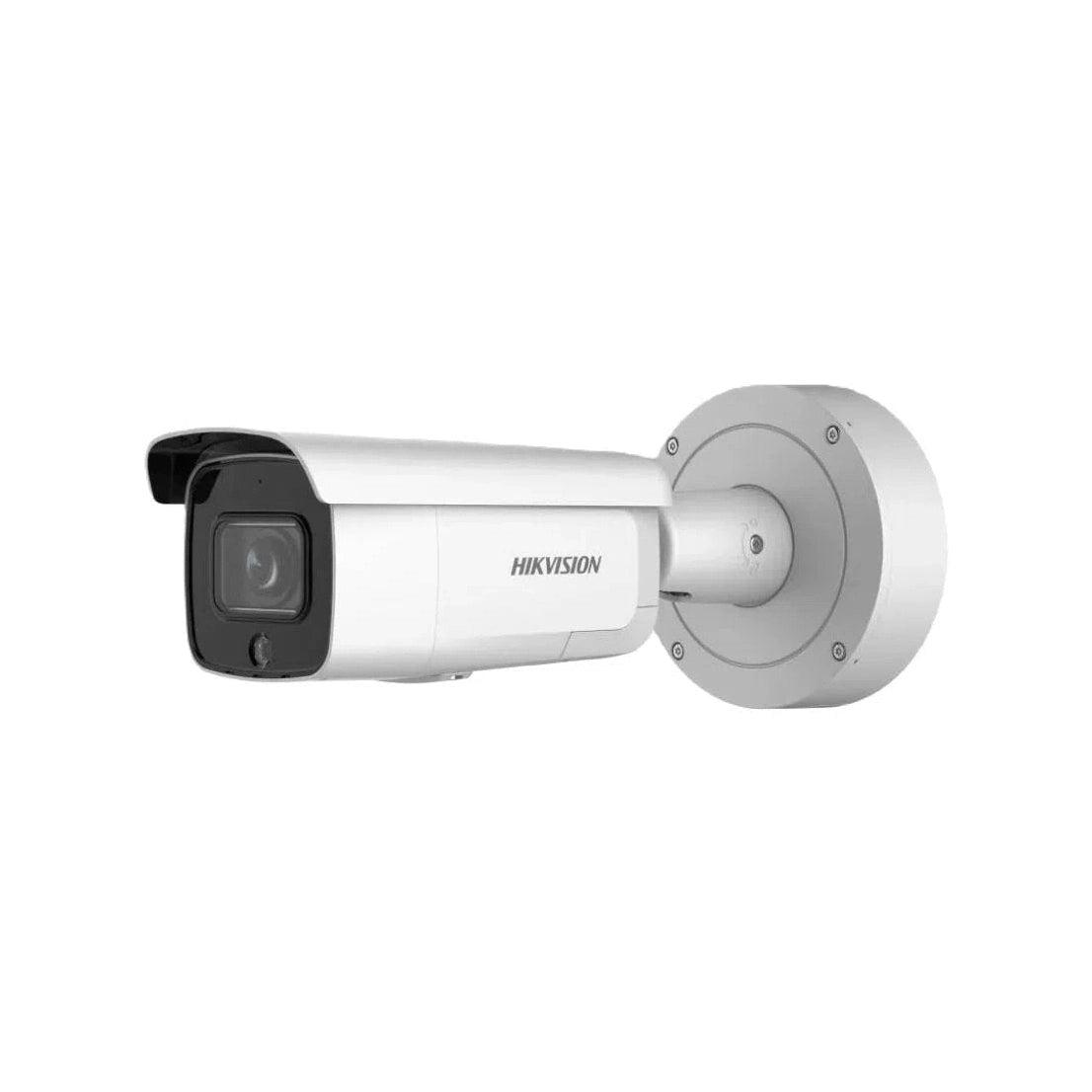
Hikvision 6MP DS-2CD2666G2-IZSU/SL AcuSense Strobe Light and Audible Warning Varifocal Bullet 2.8~12mm
Login to buyFeatures:
- High quality imaging with 6 MP resolution
- Motorized varifocal lens for easy installation and monitoring
- Excellent low-light performance with powered-by-DarkFighter technology
- Clear imaging against strong back light due to 120 dB true WDR technology
- Efficient H.265+ compression technology
- Focus on human and vehicle targets classification based on deep learning
- Active strobe light and audio alarm to warn intruders off
- Provide real-time security via built-in two-way audio
- Water and dust resistant (IP66) and vandal resistant (IK10)
-
Vendor:
HIKVision
- Tags: 6mp, Acusense, Bullet camera, New arrival, Offers
- Description
Product Overview
Most cameras make you choose between two things you actually want. You can have a camera that reacts to intruders, or a camera you can re-aim without a ladder — but almost never both in the same housing.
The Hikvision DS-2CD2666G2-IZSU/SL is the exception, and it is the only camera in our range that does it. A motorised varifocal lens covering 2.8–12 mm lets you set and change the framing remotely from software — no ladder, no re-mounting, no ordering a second camera because the first one framed too wide. And when AcuSense confirms a person or vehicle, an active strobe light fires, an audible warning sounds, and you can speak directly to whoever is there through two-way audio.
It is also unusually tough for a bullet. IK10 vandal resistance normally appears on domes, because a bullet sitting on an arm is the easiest housing to knock out of alignment. Having the impact rating on a form factor that is both visible and reachable is a genuinely uncommon combination.
Behind that sits the same G2 imaging platform as the rest of our Hikvision range: 6MP resolution, powered-by-DarkFighter low-light processing, 120 dB true WDR and H.265+ compression, in an IP66-rated housing.
Which Hikvision Bullet Do You Need?
We stock three 6MP Hikvision bullets and they do quite different jobs. Check the model number carefully before ordering — the differences matter more than the similarity in name suggests.
| Model | Lens | Deterrence & audio | Choose it when |
| DS-2CD2666G2-IZSU/SL | Motorised 2.8–12 mm | Strobe, warning, two-way | This page — you want deterrence AND remote framing |
| DS-2CD2066G2-IU/SL | Fixed 2.8 mm | Strobe, warning, two-way | Deterrence on a position where framing is obvious |
| DS-2CD2T66G2-4I | Fixed 2.8 mm | None — video only | Long-range night coverage, no audio or deterrence needed |
All three share the same 6MP imaging platform, DarkFighter low-light processing and AcuSense classification, so you are choosing capability rather than picture quality. This model is the only one of the three with a motorised lens and the only one with an IK10 impact rating.
Key Capabilities
Motorised Varifocal 2.8–12 mm
The lens zooms and focuses under motor control from software, so framing is set from the ground rather than on a ladder — and can be changed months later without touching the camera. On a site where the layout is still settling, or a position that is difficult to reach again, that flexibility is worth real money.
Active Strobe and Audible Warning
A strobe fires and an audible warning sounds when AcuSense confirms a person or vehicle. The value is entirely in the timing — a response delivered while someone is still deciding whether to proceed does work that footage reviewed the next morning cannot.
Two-Way Audio
Built-in microphone and speaker support live two-way talk from the app, from anywhere. An automated warning tells someone a system noticed them. Speaking to them directly makes clear a real person is watching in real time, and that ends the great majority of situations within seconds.
IK10 Vandal Resistance
The highest impact rating in the IEC 62262 scale, and unusual on a bullet housing. Bullets are visible and often reachable, which normally makes them the vulnerable form factor — having the impact rating here means the camera can go on a public-facing wall without being the obvious weak point.
AcuSense Classification
Deep learning decides whether motion came from a person, a vehicle, or something you do not care about, before anything triggers. On a deterrence camera this accuracy matters twice over — it governs your notifications and it decides when the strobe and warning fire. A camera that alarms at possums becomes a neighbourhood complaint quickly.
Powered-by-DarkFighter Low Light
Hikvision's low-light imaging technology, holding usable colour at light levels where a standard camera has already switched to greyscale. On a deterrence camera doing most of its work after dark, that extended colour window is exactly where the evidence value sits.
120 dB True WDR
Balances exposure across bright and dark areas of the same frame — the feature that saves the shot of someone standing in a gateway with bright sky behind them, and stops headlights washing out a driveway view every time a vehicle turns in.
6MP Resolution
Enough pixel density to crop into a recorded frame and still resolve something identifiable — and on a varifocal camera that headroom stacks with the optical zoom. You can frame tightly with the lens and crop the recording afterwards.
H.265+ and IP66 Housing
H.265+ compresses substantially harder than H.264, extending retention on the same drive. The housing is IP66 rated — dust-tight and protected against powerful water jets — with an integrated sunshade that helps with direct sun and driving rain on exposed positions.
Best For
Adjust remotely as the site settles
Re-aim without a ladder, months later
IK10 where a normal bullet would be a target
Intervention rather than documentation
Frame the boundary, warn people off it
Zoom concentrates 6MP where it counts
Why Choose This One
There is a specific situation this camera solves that nothing else in our range does, and it comes up more often than people expect.
You want the camera to intervene, and you are not certain how it should be framed. A yard where the problem area moved. A commercial frontage where the layout is still changing. A boundary you have never covered before and cannot judge from a plan. A position on a second storey or a high gable where getting a ladder back up is a genuine job. In all of those, a fixed-lens deterrence camera commits you to a decision made too early — and the only way to fix it is to climb back up.
The motorised lens removes that. Mount the camera, look at the live picture, dial the zoom until the framing is right — and change it again in six months from software if the site changes. That flexibility on its own justifies a varifocal camera on the right position, and it is genuinely rare to find it combined with an active response.
The IK10 rating adds a third thing. A deterrence camera works partly by being visible, and anything visible on a public-facing wall is reachable. Most bullets in that position are the easiest thing on the system to disable. This one is rated to take a deliberate strike.
What you should not buy it for is a position you already understand. If the framing is obvious — a standard driveway, a fixed doorway — the fixed-lens deterrence bullet does the same job for less, and we will tell you so. The zoom earns its price when the framing is genuinely uncertain or the mounting position is awkward.
Total Security Equipment supplies genuine Hikvision Australian stock from showrooms in Melbourne and Sydney, with compatible NVRs, brackets, junction boxes and PoE gear on the shelf, trade accounts for installers, and local warranty handling.
Buyer Decision Tips
Key Features & Technical Specifications
| Model | DS-2CD2666G2-IZSU/SL |
| Camera Type | 6MP AcuSense motorised varifocal deterrence bullet |
| Resolution | 6MP |
| Lens | Motorised varifocal 2.8–12 mm |
| Image Sensor | 1/2.4" Progressive Scan CMOS |
| Min. Illumination | Color: 0.003 Lux @ (F1.4, AGC ON),B/W: 0 Lux with IR |
| IR Range | Up to 60 meters |
| ULow Light | Powered-by-DarkFighter technology |
| Wide Dynamic Range | 120 dB true WDR |
| Analytics | AcuSense — human and vehicle classification via deep learning |
| Visual Alarm | Active strobe light |
| Audible Alarm | Audio alarm to warn intruders off |
| Two-Way Audio | Yes — built-in microphone and speaker |
| Video Compression | H.265+ / H.265 / H.264+ / H.264 |
| Ingress Protection | IP66 — dust-tight, protected against powerful water jets |
| Impact Protection | IK10 — highest impact rating (IEC 62262) |
| Housing | Bullet with integrated sunshade |
| Power | PoE — 12 VDC ± 25%, 1.08 A, max. 13 W, two-core terminal block, reverse polarity protection, PoE: IEEE 802.3at, Class 4, max. 15 W |
Ideal Use Cases
Commercial Perimeters and Yards
Frame the boundary precisely with the zoom, then let the strobe and warning handle anyone who crosses it. On a yard where the problem area shifts — a new stock location, a changed access route — the framing follows without anyone going back up a ladder.
Public-Facing Walls and Frontages
A deterrence camera works partly by being seen, and anything visible at street level is reachable. IK10 means this can go on a public-facing wall at head height and take a deliberate strike — which is exactly where a standard bullet would be the weakest point in the system.
High or Awkward Mounting Positions
A second-storey eave, a high gable, a pole, a position over a roof pitch — anywhere getting a ladder back up is a genuine job. Motorised zoom means the framing can be corrected from software months later, which on some sites is worth the price difference by itself.
Rear Doors and Service Areas
Loitering and after-hours access at service areas is common and rarely worth attending in person. Frame tightly on the doorway with the zoom, let the warning handle the first response, and speak to whoever is there directly from the app if they persist.
Sites Where the Problem Keeps Moving
This is the case that justifies a motorised deterrence camera specifically, and it is more common on commercial sites than anyone plans for. The trouble starts at the rear gate, so you cover the rear gate — and then it moves to the side fence. Then the bin area. Then the loading dock once the layout changes. With fixed cameras each shift means another unit, another cable run, or a ladder and a guess. With a motorised lens you follow the problem: re-frame from software, redraw the detection zone, and the deterrence goes with it. On a site with an active, shifting problem, one camera you can re-aim is worth more than two you cannot.
Choosing the Right Model
Choose this model if…
- You want deterrence and the ability to re-frame remotely — nothing else in our range does both.
- The final coverage requirement is not settled, or the site layout may change.
- The mounting position is high, awkward or hard to reach again.
- The camera is on a public-facing wall where IK10 matters.
- You need identification detail at mid distance rather than wide coverage.
- You want to speak to people on site from your phone.
Choose a different model if…
- The framing is obvious and fixed. The DS-2CD2066G2-IU/SL gives the same deterrence and two-way audio with a fixed lens for less.
- You need long-range night coverage. The DS-2CD2T66G2-4I has extended IR — but no audio and no deterrence.
- You do not need deterrence at all. A standard AcuSense turret records just as well for less.
- The camera is close to neighbours and a warning would cause more problems than it solves. A standard turret gives the same AI detection quietly.
- You want a discreet, low-profile housing. A turret or dome is less visually prominent.
- You need colour footage right through the night. ColorVu runs a permanent white light.
FAQs
What does motorised varifocal actually mean?
The lens zooms between 2.8 mm and 12 mm, and the zoom is driven by a motor you control from software rather than by hand. On a fixed-lens camera the field of view is decided when you order and cannot be changed. On this one you mount the camera, look at the live picture, and adjust the framing remotely until it is right — including months later, without touching the camera.
How is this different from your other Hikvision bullets?
We stock three 6MP Hikvision bullets. This one has a motorised zoom lens, strobe and audible warning, two-way audio and an IK10 vandal rating. The DS-2CD2066G2-IU/SL has the same deterrence and audio but a fixed 2.8 mm lens. The DS-2CD2T66G2-4I has extended long-range infrared but no audio and no deterrence at all. All three share the same imaging platform — see the comparison table above.
Why does IK10 matter on a bullet?
Because bullets are normally the vulnerable housing. They sit on an arm, they are visible from a distance, and on a wall at head height they are the easiest thing on a system to knock out of alignment or disable. Vandal ratings usually appear on domes for exactly that reason. Having IK10 on a bullet means you can put a visibly deterrent camera somewhere reachable without it becoming the weak point.
Is IP66 as good as IP67?
For any normal CCTV position, yes. IP66 means dust-tight and protected against powerful water jets — rain, hose spray, coastal moisture and driving weather are all comfortably covered. IP67 adds protection against temporary immersion, which only matters somewhere the camera could genuinely end up underwater. On a wall, eave or pole mount you will not notice the difference. Seal the cable entry properly either way, because that join is where outdoor failures actually start.
Can I zoom it from my phone?
Zoom is controlled through the camera's own interface and through compatible Hikvision software and recorders. Exactly where the control appears depends on the NVR and app you are using, so it is worth confirming your zoom controls work before you close up the installation rather than discovering it afterwards. Send us your recorder model and we will check.
If I change the zoom, do I need to redo my detection zones?
Yes, and this catches people out. Detection zones are drawn against the camera's frame, so zooming in or out means the zone no longer covers the same physical area — a tripwire you drew across a gate could end up across a footpath. Any time you adjust the framing, go back and confirm the zones still sit where you intended, then walk the boundary after dark to test it.
Does active deterrence actually work?
For opportunistic intrusion, generally yes — opportunists depend on being unobserved and unhurried, and a strobe with an audible warning removes both conditions immediately. It is less relevant against someone who has specifically targeted a property and expects a response. Treat it as a strong first layer that resolves most casual incidents, not as a substitute for locks, lighting and an alarm system. The 6MP imaging is your fallback.
Will the strobe and warning go off constantly?
Not if it is configured properly. The response triggers on AcuSense classification, so it reacts to people and vehicles rather than animals, foliage or shadows, and detection zones narrow it further to specific areas. The usual cause of nuisance triggering is a zone drawn too wide, taking in a road or footpath — and on this camera, a zone left unchanged after a zoom adjustment.
Is a varifocal camera worth it over a fixed lens?
For most positions, no — a fixed lens is cheaper and perfectly adequate where the framing is obvious. It is worth it in two situations: when you need identification detail beyond about ten metres, which optical zoom achieves and extra megapixels do not; and when the framing is uncertain or the mounting position is hard to reach again. On a site where the problem area keeps moving, it is worth it every time.
Do bullet cameras really get spider webs?
Yes, and it is the most common complaint about them in Australia. The sunshade and body give spiders anchor points, and a web across the lens reflects infrared straight back at night — which on a deterrence camera can mean the strobe and warning firing repeatedly at nothing. Mount with clear air around the housing, avoid tucking it into an eave corner, and wipe the sunshade over occasionally as normal maintenance.
Are there legal considerations with the audio or the warning?
Two worth checking. Audio recording is governed by state and territory surveillance device legislation restricting the recording of private conversations — in Victoria the Surveillance Devices Act 1999. A speaker adds a further dimension in shared or public-facing spaces, so signage matters and legal advice is sensible for a workplace or publicly accessible site. Separately, an audible warning near residential neighbours may fall under local council noise provisions.
Where can I buy it and what support is included?
Available from Total Security Equipment online and across both showrooms, with Australia-wide shipping and compatible Hikvision NVRs, brackets, junction boxes and PoE gear in stock. Trade accounts and volume pricing are available for installers, and our team can advise on framing, zone setup and NVR compatibility before you order.
Additional Information
Melbourne HQ
26 Davies Ave., Sunshine North, VIC 3020
03 9079 5566
Sydney Branch
38 Lisbon St., Fairfield East, NSW 2165
02 8722 0348
Ordering & Support
- Australia-wide shipping
- Genuine Hikvision Australian stock
- Compatible NVRs, brackets and junction boxes in stock
- Trade accounts and volume pricing
- Phone support on framing, zone setup and NVR compatibility
- Download Spec Sheet
Not sure whether you need the motorised zoom or whether a fixed-lens deterrence bullet would do? Call our Melbourne team on 03 9079 5566 or Sydney on 02 8722 0348 — describe the position and we will tell you honestly which model fits.