SKU:DS-2CD2T66G2-4I
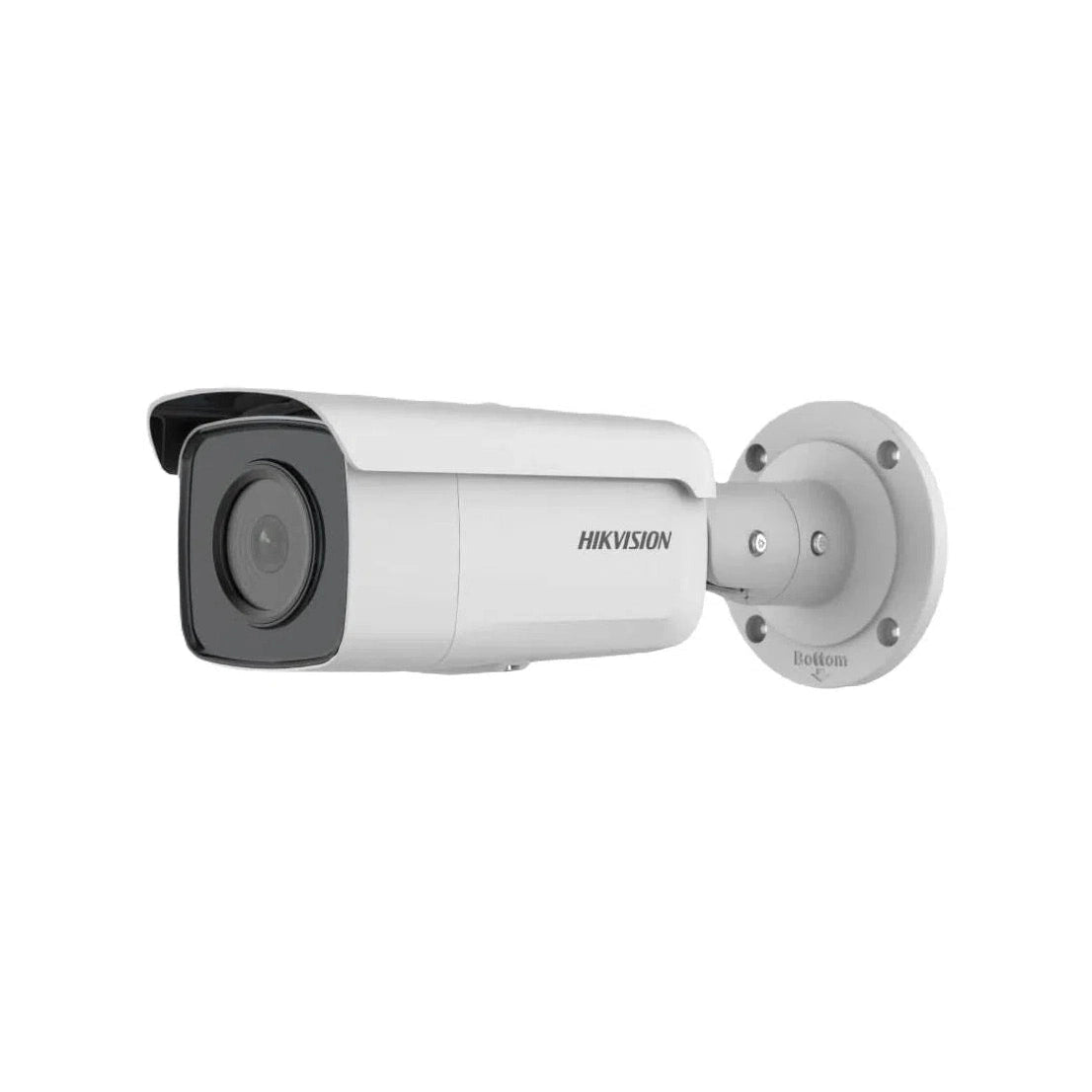
Hikvision 6MP DS-2CD2T66G2-4I AcuSense Fixed Bullet 2.8mm
Features:
- High quality imaging with 6 MP resolution
- Excellent low-light performance with powered-by-DarkFighter technology
- Efficient H.265+ compression technology
- Clear imaging against strong back light due to 120 dB true WDR technology
- Focus on human and vehicle targets classification based on deep learning
- Water and dust resistant (IP67)
-
Vendor:
HIKVision
- Tags: 6mp, Acusense, Bullet camera, New arrival, Offers
- Description
Product Overview
Most cameras stop being useful at about thirty metres after dark. Not because the sensor runs out — because the infrared does. The lens can still see; there is simply nothing out there to see it by.
The Hikvision DS-2CD2T66G2-4I is the long-reach camera in Hikvision's G2 range. The -4I designation marks it as the extended-infrared model, and the bullet housing exists to accommodate the larger IR array that reach requires. On a long driveway, a deep yard or a rural boundary, that is the difference between the far end of the scene being visible at 2am and disappearing into black.
Inside is the same well-regarded imaging platform as the rest of the G2 family: 6MP resolution, powered-by-DarkFighter low-light processing, 120 dB true WDR for backlit scenes, and AcuSense deep-learning human and vehicle classification to keep alerts credible. H.265+ compression keeps storage demands manageable, and IP67 sealing suits exposed outdoor mounting.
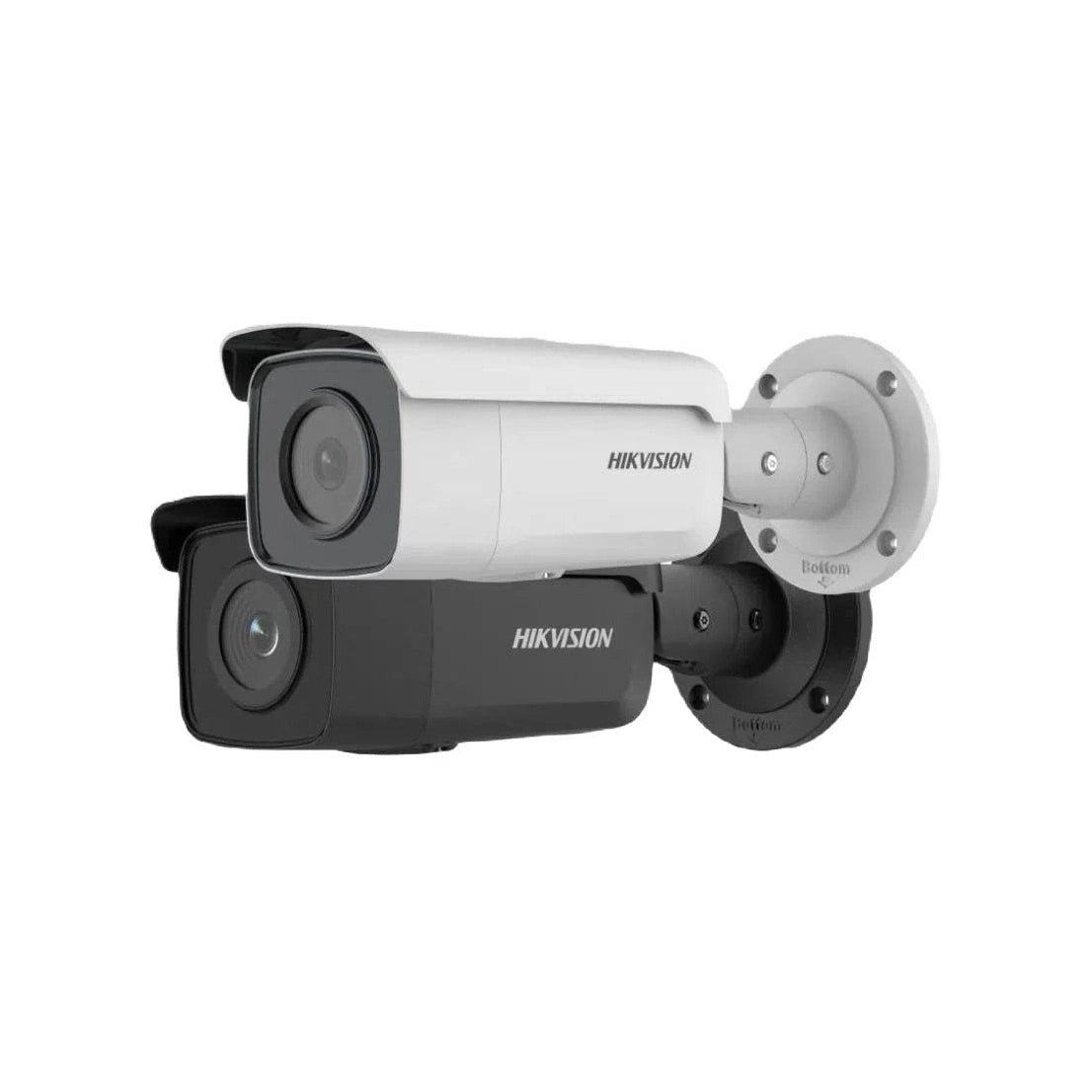
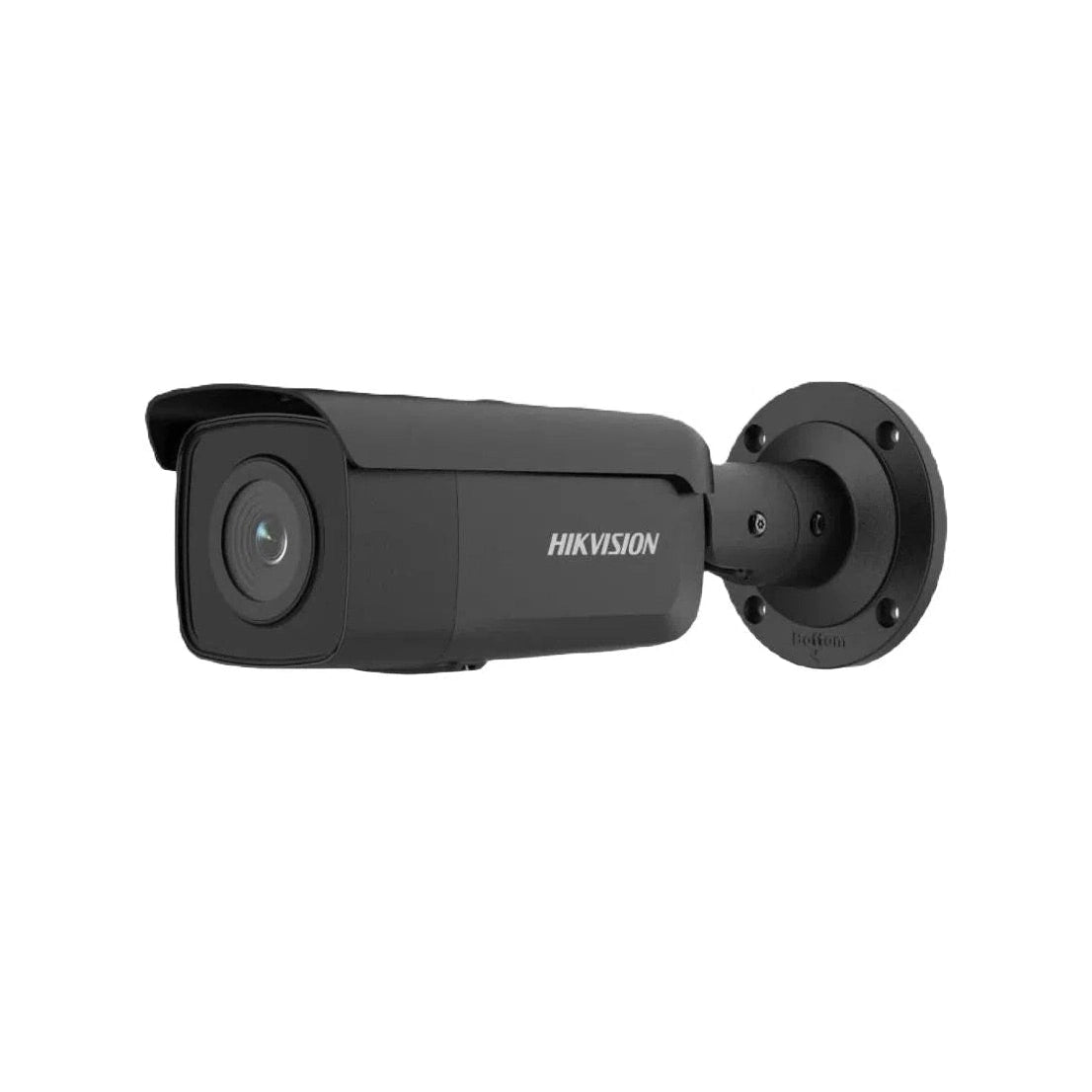
Available in white or black with a 2.8 mm lens, powered over a single PoE cable run.
Which Hikvision G2 Camera Do You Need?
We stock four cameras built on this same imaging platform — same 6MP sensor family, same DarkFighter low light, same AcuSense classification, same 120 dB WDR. What differs is the housing and the extra features. This is the practical comparison.
| Model | Housing | Extra features | Choose it when |
| DS-2CD2T66G2-4I | Bullet | Long-range IR | This page — you need night coverage at distance |
| DS-2CD2366G2-IU | Turret | Built-in microphone | Standard eave or wall position, audio wanted |
| DS-2CD2366G2-ISU/SL | Turret | Strobe, speaker, alarm I/O | You want the camera to warn people off, not just record |
| DS-2CD2166G2-ISU | Dome | IK10 vandal rating, alarm I/O | The camera is within reach and could be interfered with |
Because they share an imaging platform, you are choosing a housing and a feature set rather than compromising on picture quality. Mixing them across one property is entirely normal and usually the right approach — a bullet on the long driveway, a vandal dome on the reachable side wall, a deterrence turret at the rear door.
Key Capabilities
Long-Range Infrared
The reason to choose this model over the turret or dome versions. The extended IR array reaches considerably further than a standard camera, which is what keeps the far end of a long driveway, a deep yard or a rural boundary visible at night rather than fading into black at thirty metres.
Powered-by-DarkFighter Low Light
Hikvision's low-light imaging technology, which holds usable colour at light levels where a standard camera has already switched to greyscale. Colour is the first descriptor anyone asks for after an incident, so extending the window where it is available matters more than most specifications on the sheet.
AcuSense Human and Vehicle Classification
Deep learning decides whether motion came from a person, a vehicle, or something you do not care about, before any alert is sent. Foliage, rain, pets and wildlife are filtered out. On a long-range camera this matters even more than usual — a wide, deep scene catches far more incidental movement than a close one.
6MP Resolution
Enough pixel density to crop into a recorded frame and still resolve something identifiable. On a camera watching a deep scene that headroom is the difference between knowing something happened at the far gate and knowing what it was.
120 dB True WDR
True wide dynamic range balances exposure across bright and dark areas of the same frame — the feature that saves the shot of someone standing in a gateway with bright sky behind them, and stops headlights washing out a driveway view every time a car turns in.
Integrated Sunshade
The bullet housing carries a built-in sunshade over the lens, which helps considerably with direct sun, low-angle glare and driving rain on exposed positions. On a west-facing wall or an unshaded pole this earns its keep every evening.
Visible Deterrent Profile
A bullet is recognisable as a camera from a distance in a way a turret or dome is not. On a front boundary, a commercial frontage or a yard perimeter, being obviously watched is a deterrent in itself — and it is one of the practical reasons installers choose bullets for outward-facing positions.
H.265+ Compression
Compresses substantially harder than H.264 for the same picture quality, extending how far back your recorder history reaches on the same drive and reducing the bandwidth each camera consumes on a shared NVR budget. Meaningful across a multi-camera install.
IP67 Sealed, PoE Powered
Fully dust-tight and sealed against water for exposed wall, eave and pole positions including coastal and high-humidity sites. Powered over a single Cat5e or Cat6 run carrying data and power together, with no plug pack needed at the camera end.
Best For
Extended IR reaches the far gate at night
Coverage where standard IR runs out
No ambient light to work with
Integrated sunshade handles glare
Visible as a camera — deterrent in itself
Pole and wall mounting along a sightline
Why Choose the Long-Range Bullet
There is a problem on deep properties that no amount of resolution solves, and it catches people out constantly: at night, your camera can only see as far as its infrared reaches. Beyond that the sensor is looking at nothing. A 6MP camera with thirty metres of IR and an 8MP camera with thirty metres of IR both stop showing you anything useful at the same distance.
Extended IR is the only fix for that, and it is why this camera exists in the range alongside its turret and dome siblings. Where a standard camera fades out partway down a long driveway, this one keeps going — which on a rural block, a deep yard or a long boundary is the difference between a camera that covers the area and one that covers the first third of it.
The bullet housing is there for practical reasons, not styling. A larger IR array needs somewhere to live, the integrated sunshade protects the lens on exposed positions, and the shape is straightforward to aim along a fence line or driveway from a wall or pole. It is also visibly a camera from a distance, which has genuine deterrent value on an outward-facing position.
What you are not doing is trading away image quality. This uses the same imaging platform as the rest of the Hikvision G2 range — DarkFighter low light, 120 dB WDR, AcuSense classification, 6MP resolution. If your positions are all within thirty metres, one of the turret models will serve you just as well for less, and we will tell you so. The reach is the reason to buy this one.
Total Security Equipment supplies genuine Hikvision Australian stock from showrooms in Melbourne and Sydney, with compatible NVRs, brackets, junction boxes and PoE gear on the shelf, trade accounts for installers, and local warranty handling.
Buyer Decision Tips
Key Features & Technical Specifications
| Model | DS-2CD2T66G2-4I |
| Camera Type | 6MP AcuSense fixed bullet |
| Resolution | 6MP |
| Image Sensor | [CONFIRM SENSOR SIZE FROM DATASHEET] |
| Lens | 2.8 mm fixed |
| IR Range | [CONFIRM IR RANGE — extended, per the -4I designation] |
| Low Light | Powered-by-DarkFighter technology |
| Wide Dynamic Range | 120 dB true WDR |
| Analytics | AcuSense — human and vehicle classification via deep learning |
| Video Compression | H.265+ / H.265 / H.264+ / H.264 |
| Audio | None — no built-in microphone on this model |
| Alarm Interface | None on this model |
| Ingress Protection | IP67 — dust-tight and water resistant |
| Housing | Bullet with integrated sunshade |
| Colour Options | White or black |
| Power | PoE — [CONFIRM CLASS AND WATTAGE] |
Ideal Use Cases
Long Driveways and Rural Entries
The clearest case for extended infrared. Where the gate sits well back from the house and there is no street lighting, a standard camera shows you the first thirty metres and darkness beyond. This keeps the whole approach visible, so a vehicle arriving at the far end is recorded rather than appearing suddenly halfway up the drive.
Deep Yards and Property Boundaries
Rear boundaries, paddock fences and large yards are where most systems have their real weak spot — there is usually no lighting at all, and a standard camera simply stops working at the point where the trouble tends to start. Extended IR reaches into that space.
Commercial Perimeters and Yards
Industrial yards, storage compounds and loading areas need night coverage across open ground with no ambient light. Mounted on a pole or wall aimed along the boundary, the bullet form factor suits the sightline and the visible profile adds deterrent value at the fence line.
Exposed and Sun-Facing Positions
The integrated sunshade earns its keep on a west-facing wall, an unshaded pole or a rooftop where low sun would otherwise flare the lens for an hour every evening. Combined with 120 dB WDR, this handles harsh directional light better than a housing without one.
The Gap in Almost Every System
Most properties we see have the same weakness, and it is rarely the front door. Four or six cameras cover the entries, the driveway and the back door perfectly well — and then there is one position that was quietly given up on because it is too far away and too dark. The rear boundary. The far paddock gate. The end of a hundred-metre drive. Adding more standard cameras does not solve it; they would run out of infrared at the same distance. This is the camera that fills that gap, and on most systems adding one closes the last genuine hole rather than duplicating coverage that already works.
Choosing the Right Model
Choose this model if…
- You need night coverage beyond the range of a standard camera.
- The position is unlit — a rural driveway, a rear boundary, an open yard.
- The camera is exposed to direct sun or driving rain.
- You are mounting on a pole or wall aimed along a sightline.
- A visible camera has deterrent value at that position.
- You do not need audio or alarm terminals at that camera.
Choose a different model if…
- All your positions are within about 30 m. A G2 turret does the same imaging for less — you would be paying for reach you will not use.
- You want audio recorded. The DS-2CD2366G2-IU turret has a built-in microphone.
- You want alarm I/O or active deterrence. The ISU/SL turret or ISU dome carry those.
- The camera is within reach and could be interfered with. The IK10 vandal dome is built for that.
- You need identification detail at distance. Long IR shows you something is there; a motorised varifocal shows you who.
- You need colour footage through the night. ColorVu runs a permanent white light for continuous colour.
FAQs
How far can this camera see at night?
As far as its infrared reaches, and the "-4I" designation marks this as the extended-IR model in the Hikvision G2 range — considerably further than a standard camera. Beyond the IR range there is no light for the sensor to work with, so that figure is the practical limit of night coverage regardless of resolution. Tell us the distance you need to cover and we will confirm this camera reaches it before you order.
Does more megapixels mean I can see further at night?
No, and this catches people out regularly. At night the limit is how far the infrared reaches, not how many pixels the sensor has. A 6MP camera and an 8MP camera with the same IR range will both stop showing you anything useful at the same distance. If your problem is that the far end of a driveway disappears into black, the answer is a longer IR range — which is what this model provides — rather than a higher-resolution camera.
Can it identify someone at the far end of the IR range?
No — and this is an important distinction. Infrared range is how far the camera can see. Identification distance is set by the lens and sensor, and on a wide 2.8 mm lens it is much shorter. So this camera will show you a vehicle arriving at the far end of a long driveway, but identifying who stepped out of it needs them considerably closer, or a second camera with optical zoom aimed at that point. Long IR gives you awareness at distance, not evidence at distance.
Should I choose a bullet, turret or dome?
Bullets suit exposed and long-range positions — the sunshade helps with sun and rain, the housing accommodates a bigger IR array, and the visible profile is a deterrent. Turrets are lower profile, easier to aim and attract fewer spider webs, which makes them the sensible default for standard eave positions. Domes with an IK10 rating are for anywhere a person could reach the camera. All four of our G2 cameras share the same imaging platform, so you are choosing a housing rather than compromising on picture quality — see the comparison table above.
Do bullet cameras really get spider webs?
Yes, and it is the most common complaint about them in Australia. The sunshade and body give spiders anchor points, and a web across the lens reflects infrared straight back at night, producing white blur or repeated false triggers. On a long-range camera the effect is worse because there is more IR light to bounce back. It is manageable — mount with clear air around the housing, avoid tucking it into an eave corner, and wipe the sunshade over occasionally as normal maintenance.
Does it have a microphone or alarm terminals?
No. This model is video only. In Hikvision's naming, a "U" indicates a built-in microphone and an "S" indicates an audio and alarm interface — neither appears in this model number. If you need audio at that position, the DS-2CD2366G2-IU turret has a microphone. If you need alarm input and output terminals, the ISU/SL turret or the ISU dome carry them.
What does DarkFighter do?
It is Hikvision's low-light imaging technology, combining sensor design and image processing to produce usable colour at very low light levels. The practical effect is that the camera stays in colour mode for longer as light fades, rather than switching to greyscale infrared. Since colour is the first descriptor anyone asks for after an incident, that extended window is worth real money — particularly on a site with some street lighting or spill.
What does AcuSense do?
It uses deep learning to classify targets as human or vehicle on the camera itself, before an alert is sent. Foliage, rain, shadows, pets and wildlife are filtered out. Two benefits follow: your notifications stay credible enough that you keep reading them, and recorded footage becomes searchable by target type, so reviewing an overnight period takes minutes rather than hours.
Will it work on a non-Hikvision NVR?
Video recording will generally work over ONVIF. AcuSense classification and searchable analytic events depend on the recorder understanding Hikvision events, which in practice means a compatible Hikvision NVR. Since the AI is a good part of the reason to buy an AcuSense camera, pairing it accordingly is sensible — send us your recorder model and we will confirm before you order.
Will it cope with exposed Australian conditions?
Yes. IP67 means fully dust-tight and rated against temporary water immersion, and the integrated sunshade adds real protection against direct sun and driving rain — one of the reasons a bullet suits exposed positions. Seal the cable entry and use a weatherproof junction box for any termination, because that join rather than the housing is where outdoor failures almost always begin.
Where can I buy it and what support is included?
Available from Total Security Equipment online and across both showrooms, with Australia-wide shipping and compatible Hikvision NVRs, brackets, junction boxes and PoE gear in stock. Trade accounts and volume pricing are available for installers, and our team can advise on mounting, coverage distance and NVR compatibility before you order.
Additional Information
Melbourne HQ
26 Davies Ave., Sunshine North, VIC 3020
03 9079 5566
Sydney Branch
38 Lisbon St., Fairfield East, NSW 2165
02 8722 0348
Ordering & Support
- Australia-wide shipping
- Genuine Hikvision Australian stock
- Available in white or black
- Compatible NVRs, brackets and junction boxes in stock
- Trade accounts and volume pricing
- Phone support on coverage distance and NVR compatibility
- Download Spec Sheet
Not sure whether you need the extended IR or whether a standard turret would cover it? Call our Melbourne team on 03 9079 5566 or Sydney on 02 8722 0348 — tell us the distance you need to cover at night and we will tell you honestly which model suits.