SKU:IPC-T289PH-MU/SL
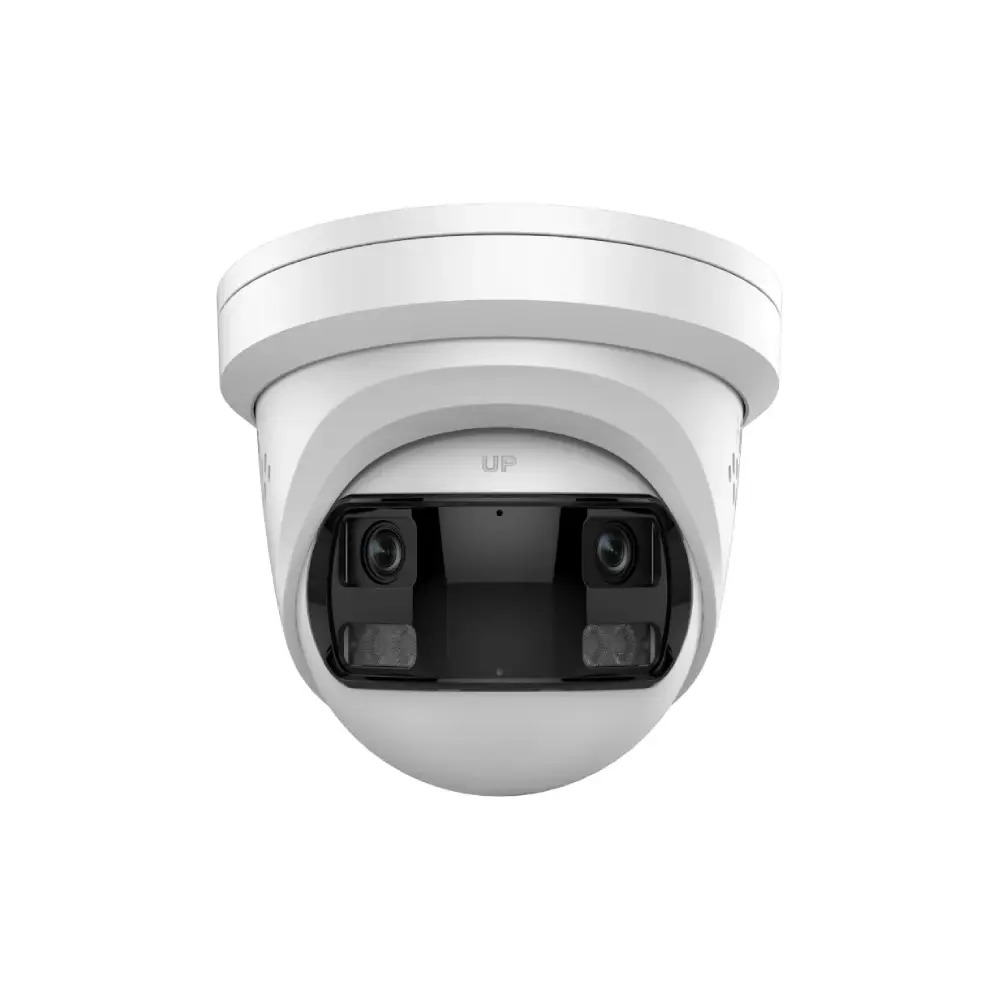
Hilook IPC-T289PH-MU/SL 4K All-in-One 180°Fixed Turret Network Camera
Login to buy8 MP Dual Lens Stitched Wide Angle Smart Hybrid Light Fixed Turret Network Camera
- High quality imaging with 8 MP resolution
- Support Person and Vehicle Detection
- Smart Hybrid Light: advanced technology with long range
- Efficient H.265+ compression technology
- Support on-board storage up to 512 GB (SD card slot)
- Provide real-time security via built-in two-way audio
- Water and dust resistant (IP67)
- 180° Field of view
- Active strobe light and audio alarm to warn intruders off


- Description
Product Overview
Stand at the corner of any building and you have the same problem: two walls, two directions, and a standard camera that can only look at one of them. The usual answer is two cameras, two cable runs, two mounts, two channels on the recorder.
The HiLook IPC-T289PH-MU/SL solves that with two lenses in one housing. Each sensor covers half the scene and the camera stitches them together internally into a single seamless 180° panoramic image at 4256 × 1888. One camera, one cable, one recorder channel — covering what would normally take two of everything.
It is an all-in-one unit rather than a bare camera. Smart Hybrid Light combines infrared and white LED illumination, person and vehicle detection filters out the animals and foliage that make motion alerts useless, and an active strobe and audio alarm plus two-way audio mean it can warn someone off and let you speak to them rather than simply recording the event. Add 0.005 lux colour sensitivity, H.265+ compression, microSD to 512 GB, IP67 sealing and PoE.
One thing to understand before ordering: a panoramic camera trades detail for coverage. Read the first buyer tip below — it explains exactly what that means and where this camera should and should not be used.
Key Capabilities
Dual-Lens 180° Stitched Panorama
Two sensors, each covering half the field, blended in-camera into one continuous image. Unlike a fisheye, there is no circular distortion and no software de-warping to configure — the recorder receives a normal rectangular video stream that happens to be very wide. Vertical field of view is 77°.
One Camera Instead of Two
The practical economics are the point. A corner position normally needs two cameras, two cable runs, two brackets and two recorder channels. This covers it with one of each — which on a system that is channel-limited, or a site where cabling is difficult, is often the difference between covering an area properly and not covering it at all.
4256 × 1888 Resolution
An 8MP-class output in a wide panoramic aspect ratio on a 1/2.4″ sensor. The unusually wide frame suits the job — a long frontage, a corridor junction, a forecourt — where a conventional 16:9 image would waste most of its height on sky and ground.
Smart Hybrid Light
Infrared and white LED illumination working together, so the camera can run discreetly on infrared and bring in white light for colour capture when it matters. Colour sensitivity down to 0.005 lux, and 0 lux capability with the illuminator active.
Person and Vehicle Detection
Deep learning classification separates people and vehicles from animals, foliage and shadows before an alert is sent. On a camera watching 180° of scene this matters more than usual — a wide view catches far more incidental movement, so unfiltered motion detection would be unusable within days.
Active Strobe and Audio Alarm
A built-in strobe and audible alarm trigger when a person or vehicle is detected, so the camera intervenes rather than only documenting. The value is timing — a response delivered while someone is still deciding whether to proceed does work that footage reviewed tomorrow cannot.
Two-Way Audio
Built-in microphone and speaker let you listen and speak live from the app — addressing someone directly at a rear door or forecourt, or simply talking to a delivery driver. Considerably more effective than a recorded warning, because it makes clear a real person is watching.
512 GB Edge Storage
Double the card capacity of most cameras in this class, which matters at this resolution. Enough for genuine standalone operation where running cable back to a recorder is impractical, or as a backup layer so footage survives on the camera if the NVR drops offline or is stolen.
IP67 Housing, Full Angle Adjustment
Fully dust-tight and sealed against water for exposed outdoor positions. Pan and rotate through 360° with 75° of tilt, so the panorama can be levelled correctly — critical on this camera, since a tilted 180° image wastes coverage at both ends. Powered by 802.3af Class 3 PoE or 12 V DC.
Best For
Two walls covered from one position
Long shopfronts and facades in one frame
Full situational awareness of an open area
Cover more with fewer NVR channels
One run instead of two
Both directions from one mount
Why Choose a 180° Panoramic Camera
There is one question worth asking before you buy this camera, and it is not about resolution. It is: do I need to see a wide area, or do I need to see one thing clearly?
If the answer is a wide area, this is an unusually good tool for the job. A corner of a building, a long frontage, a forecourt, a courtyard, a junction of two corridors — all of these normally require two cameras pointed in opposite directions, with a blind spot in between where their fields of view do not quite meet. This covers the whole thing in one continuous image, with no gap and no seam to reason about, using one cable run, one bracket and one channel on the recorder. On a four-channel NVR that is the difference between covering four positions and covering six.
Because it is an all-in-one unit, it also intervenes rather than only recording. Person and vehicle detection filters the alerts down to things that matter, and the strobe, audio alarm and two-way talk let you respond to what the camera sees from wherever you happen to be.
If the answer is that you need to see one thing clearly — a gate, a till, a doorway, a number plate — then a panoramic camera is the wrong tool and we would rather tell you now. Spreading 4256 pixels across 180° means less detail per degree than a standard camera spreading 3840 across 110°. That is the deliberate trade, and it is the right one for coverage work. It is the wrong one for identification at distance. The buyer tips below explain how to plan around it.
Total Security Equipment stocks HiLook across our Melbourne and Sydney showrooms with compatible NVRs, brackets, storage and PoE gear, trade accounts for installers, and local support.
Buyer Decision Tips
Key Features & Technical Specifications
| Category | Parameter | Details |
|---|---|---|
| Camera | Image Sensor | 1/2.4" Progressive Scan CMOS |
| Max. Resolution | 4256 × 1888 | |
| Min. Illumination | Color: 0.005 Lux @ (F1.6, AGC ON), 0 Lux with light | |
| Shutter Time | 1 s to 1/100,000 s | |
| Day & Night | IR cut filter | |
| Angle Adjustment | Pan: 0° to 360°, tilt: 0° to 75°, rotate: 0° to 360° | |
| Lens | Lens Type | Fixed focal lens, 2 mm |
| Focal Length & FOV | 2 mm, horizontal FOV 180°, vertical FOV 77° | |
| Lens Mount | M12 | |
| Iris Type | Fixed | |
| Aperture | F1.6 | |
| Video | Main Stream | 50 Hz: 20 fps (4256 × 1888), 60 Hz: 20 fps (4256 × 1888) |
| Video Compression | H.265+/H.265/H.264+/H.264 | |
| Video Bit Rate | 32 Kbps to 16 Mbps | |
| General | Power | 12 VDC ± 25%, max. 10 W; PoE: IEEE 802.3af, Class 3, max. 11.5 W |
| Protection | IP67: IEC 60529-2013 | |
| Dimensions | Ø138.3 mm × 115.4 mm (Ø5.4" × 4.5") |
Ideal Use Cases
Building Corners
The textbook application. Mounted on an external corner, one camera watches both walls and the approach to each — coverage that would otherwise take two units aimed in opposite directions, with an awkward blind spot where their views fail to meet. One cable, one bracket, one recorder channel, and no gap.
Wide Shopfronts and Facades
A long retail frontage or building facade is exactly the shape this camera's panoramic aspect ratio was designed for. Where a conventional 16:9 camera wastes most of its height on sky and pavement, this puts the pixels along the frontage itself — the part where things actually happen.
Forecourts and Car Parks
Open areas need situational awareness first — knowing that something happened and roughly where — before detail. A 180° view from one edge of a forecourt gives that in a single frame, with person and vehicle detection keeping overnight alerts credible and the strobe adding a response layer.
Corridor and Walkway Junctions
Where two corridors meet, or a walkway splits, conventional cameras force a choice about which direction matters more. A 180° camera at the junction covers both, which suits apartment buildings, offices, schools and any internal layout where movement can come from either side.
Systems Running Short of NVR Channels
This is the commercially useful case that gets overlooked. Plenty of properties end up with a four or eight-channel recorder and one more position that needs covering than there are channels left — and the alternative is replacing the NVR, re-licensing, and possibly re-cabling. A panoramic camera covering what would otherwise be two positions frees a channel without touching the recorder. On a site where the cable route to a second position is genuinely difficult — through a brick wall, across a roof, under a driveway — the saving is larger still. Worth considering before anyone quotes you a bigger recorder.
Choosing the Right Model
Choose this model if…
- You need to cover a corner, a wide frontage or an open area from one position.
- Situational awareness across a wide scene matters more than identifying someone at distance.
- You are short on recorder channels, or a second cable run would be difficult.
- You want deterrence — strobe, audio alarm and two-way talk — built into the same unit.
- You want person and vehicle filtering, which matters more on a wide view than a narrow one.
- You are pairing it with a conventional camera on the specific point that needs detail.
Choose a different model if…
- You need identification detail at distance. Pixels spread across 180° means less detail per degree — a conventional fixed-lens camera resolves more at the same range.
- You need to read number plates. That is a dedicated ANPR job and a panoramic camera is the wrong tool entirely.
- The area is deep rather than wide. A long driveway wants a narrow lens or a motorised varifocal, not a panorama.
- You need smooth 25/30 fps for fast movement close to the lens. This runs at 20 fps.
- Your recorder cannot handle a 4256 × 1888 stream. Check before ordering.
- Mounting clearance is tight. The 138.3 mm housing is larger than a standard turret.
FAQs
How does a dual-lens 180° camera work?
It has two separate lenses and sensors, each covering roughly half the scene, and the camera stitches the two images together internally into one continuous panoramic frame at 4256 × 1888. Your recorder receives a single normal video stream — just an unusually wide one. There is no de-warping to configure and none of the circular distortion you get from a fisheye lens.
Is a 180° camera as detailed as a normal 8MP camera?
No, and this is the most important thing to understand before buying. Both are described as 4K, but this camera spreads roughly 4256 horizontal pixels across 180° — around 24 pixels per degree — while a conventional 8MP camera puts about 3840 pixels across 110°, roughly 35 per degree. At the same distance, the conventional camera resolves more detail. You are buying coverage and paying for it in reach. That is the right trade for watching a wide area and the wrong one for identifying someone at distance.
How is this different from a fisheye camera?
A fisheye uses one lens to capture a circular 180° or 360° image, which then needs software de-warping to be viewable — and image quality falls away noticeably toward the edges. This uses two conventional lenses stitched into a normal rectangular panorama, so there is no de-warping step, no circular distortion, and quality stays consistent across the width. It is generally the easier of the two to live with.
Can it really replace two cameras?
For coverage purposes, yes — that is the point of it. One camera, one cable run, one bracket and one recorder channel covering what would otherwise take two of each, with no blind spot in between. What it does not replace is a camera positioned tight on a specific point for identification. The most effective approach is usually one panoramic for awareness plus one conventional camera on whatever actually needs to be identified.
Will I see the join between the two lenses?
The stitching is done in-camera and is designed to be seamless in normal use. As good practice, position the camera so the single most critical detail in the scene — a doorway, a till, a gate — sits comfortably within one half of the view rather than directly at the centre where the two images meet. It costs nothing at mounting time and removes any doubt about the one frame you might later need.
Will my NVR handle it?
Check two things. First, that the recorder supports 8MP-class resolution per channel. Second — and more easily missed — that it displays the 4256 × 1888 panoramic aspect ratio correctly rather than stretching or letterboxing it. Some older or lower-spec recorders handle non-standard ratios poorly. Send us your NVR model and we will confirm before you order.
Why is it only 20 fps?
Stitching two high-resolution sensors into a single frame is processing-intensive, and 20 fps at full resolution is the result. For the work this camera does — awareness across a wide area — it is entirely adequate and you will not notice the difference. It would matter if you were covering fast movement close to the lens, which is not what a panoramic camera is for.
Does it record in colour at night?
It has Smart Hybrid Light, combining infrared and white LED illumination, and holds colour to 0.005 lux before either is needed. With the white light active it can produce colour images in zero ambient light. The exact behaviour — infrared only, white light on detection, or continuous white light — depends on the mode configured, so tell us how you want it to run and we will talk it through.
What does the strobe and audio alarm do?
When person or vehicle detection triggers in a zone you define, the camera fires a strobe and sounds an audible alarm rather than only logging the event. You can also speak live through the built-in speaker from the app. The point is timing — a response while someone is still deciding whether to continue does work that reviewing footage tomorrow cannot.
How much power does it need?
802.3af Class 3 PoE at up to 11.5 W, or 12 V DC at up to 10 W. That is higher than most cameras in the range, so on a switch already carrying several units, check the total PoE budget rather than just the port count. An overloaded budget shows up as cameras booting, dropping and rebooting rather than failing cleanly.
Is it legal to record audio in Australia?
Surveillance device laws are set at state and territory level and they differ meaningfully. As a general principle, recording private conversations without any party's knowledge is restricted. Entrances, external perimeters, yards and commercial premises with clear signage are usually the appropriate places to enable audio. Check the legislation applying in your state — in Victoria this is the Surveillance Devices Act 1999 — before switching the microphone on, and seek legal advice where the site is a workplace, shared or publicly accessible.
Where can I buy it and what support is included?
Available from Total Security Equipment online and across both showrooms, with Australia-wide shipping and compatible HiLook NVRs, brackets, storage and PoE gear in stock. Trade accounts and volume pricing are available for installers, and our team can confirm NVR compatibility, bracket options and camera placement before you order.
Additional Information
Melbourne HQ
26 Davies Ave., Sunshine North, VIC 3020
03 9079 5566
Sydney Branch
38 Lisbon St., Fairfield East, NSW 2165
02 8722 0348
Ordering & Support
- Australia-wide shipping
- Compatible HiLook NVRs and brackets in stock
- We can confirm NVR compatibility before you order
- Trade accounts and volume pricing
- Phone support on placement and system design
- Download Spec Sheet
Not sure whether one panoramic camera or two conventional ones suits your site better? Call our Melbourne team on 03 9079 5566 or Sydney on 02 8722 0348 — describe the position and we will tell you honestly which works out better.